Japanese Liquidity Just Gave Us a Key Piece of Bitcoin’s 2026 Puzzle

 |
| By Juan Villaverde |
Japanese M2, you’ll recall, is my favorite liquidity indicator. That’s because it’s been accurately forecasting Bitcoin’s (BTC, “B+”) trends for a while now.
And last week, it gave us the next big piece of the puzzle.
JpM2 has just confirmed Bitcoin's next major low, expected around Oct. 17–18:
Japan M2 Shows Crypto’s Next Big Inflexion Point
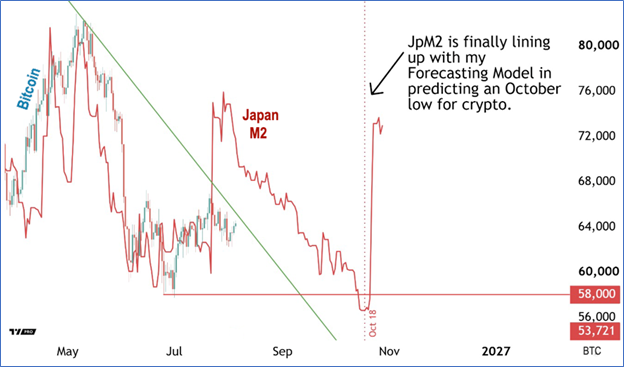
Here’s why this has me so excited: This lines up almost precisely with my Forecasting Model, which for weeks has pointed to a late-October-to-early-November low.
Two independent models, converging on nearly the same date. That's exactly the kind of confirmation I am looking for.
What triggered this?
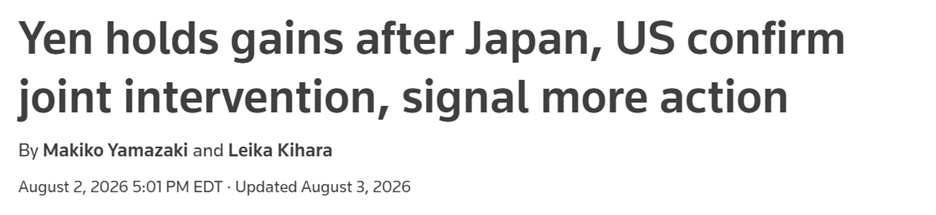
Recently, the Japanese Ministry of Finance stepped into the market and sold a meaningful amount of dollars to prop up the yen.1
That intervention is what's shown up as the projected low in JpM2's forecast.
Here's why I think this one has a real shot at being a more durable, sustainable bottom. More so than anything we've seen out of Japanese liquidity so far in 2026 …
The root cause of yen weakness throughout 2026 has been the Iran war. The blockage of the Strait of Hormuz pushed global oil prices sharply higher. And Japan, with no domestic petroleum resources, must import virtually all its energy.
But oil is priced in dollars.
That forced Tokyo to buy lots of greenbacks to cover its sharply higher import bills. That surge in dollar purchases is what's lately been crushing the yen.
The Federal Reserve and the Bank of Japan know this. Now, a couple key things are lining up in the yen's favor.
- The Federal Reserve has interest rates on hold, while the Bank of Japan continues to raise them. That interest rate differential is the single biggest driver of long-term currency moves. And it’s shrinking — which is in the yen's favor.
- And if the Iran war genuinely starts winding down, we should see oil demand pressure ease. And with it, a yen rally that actually has legs. One that lasts more than a few weeks.
That last point matters enormously.
A brief, one-off yen bounce doesn't move the needle. It just creates the type of dead-cat bounce in the price of Bitcoin we’ve already seen this year.
What we need is a sustained rally in the yen. Because that's what drives a genuine, sustained increase in dollar liquidity flowing out of Japan.
And that increase in liquidity is precisely the ingredient crypto has been missing all year.
So, the next low is confirmed by JpM2 for late October into early November. Just as my Forecasting Model has been saying all along.
And for the first time in a while, the conditions behind it look like they could stick.
Bottom Line
All the signs are lining up …
Crypto will likely remain cool until mid-October. That’s when things should start to heat up.
The last variable remains the 4-year-cycle low.
If BTC can cross above the downtrend line I’ve been watching, we’ll be able to confirm $60,000 as the floor between now and October. That should be enough to give traders confidence to jump in while we wait for sparks to fly.
Bitcoin is touching that line as I write.
But it hasn’t crossed above it, so it’s too soon to call the low. And if it can’t cross with confidence before the late summer correction begins — which should be very soon — then there’s a possibility that BTC could fall to a new low before October.
So, until we have confirmation, I urge caution.
In fact, I told my Weiss Crypto Investor members that we’ll likely keep our powder dry until October. That is, unless my Crypto Timing Model spots a chance to jump in before then.
My model doesn’t just track Bitcoin’s cycle — and, by extension, the broad market. It also follows the individual cycles of select, top-performing altcoins.
Sometimes, those leading alts move ahead of Bitcoin. My model can identify when they do, which lets us load up before most even know to pay attention.
To learn more about how my model works, and how it can help you reach your long-term crypto goals, click here.
Best,
Juan Villaverde