 |
| By Jurica Dujmovic |
When you hear about AI, chances are you’re thinking about generative AI — large language models like ChatGPT and Claude AI.
I’ve covered the broad AI market before — about the slowly deflating bubble, how to identify the TradFi projects most likely to survive it, how crypto can help and the shaky collateral underpinning all of it.
But something I haven’t focused as much on is medical AI.
This useful niche has moved from demo theater into the hospital. That makes it more useful and more investable.
Which also means it is more dangerous to analyze lazily.
Here’s the key you need to know: The metrics needed to measure successful medical AI … is vastly different from what you’ve been using.
Medical AI on the Rise
The market has spent years rewarding companies for attaching artificial intelligence to healthcare workflows. But like we saw with LLMs, that was the hype and excitement talking.
The next phase will be less forgiving.
Once an algorithm is used in diagnosis, surgery, monitoring or triage, the question is no longer whether it sounds futuristic and feels cool to use. The question is whether it can be validated, audited and defendable should something go wrong.
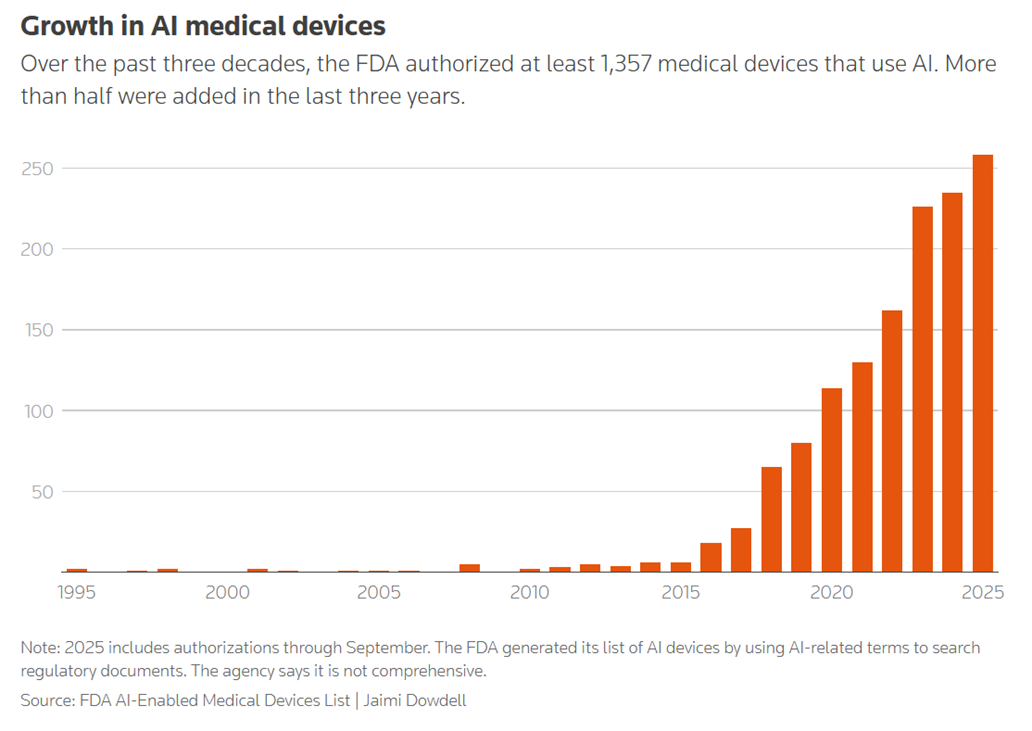
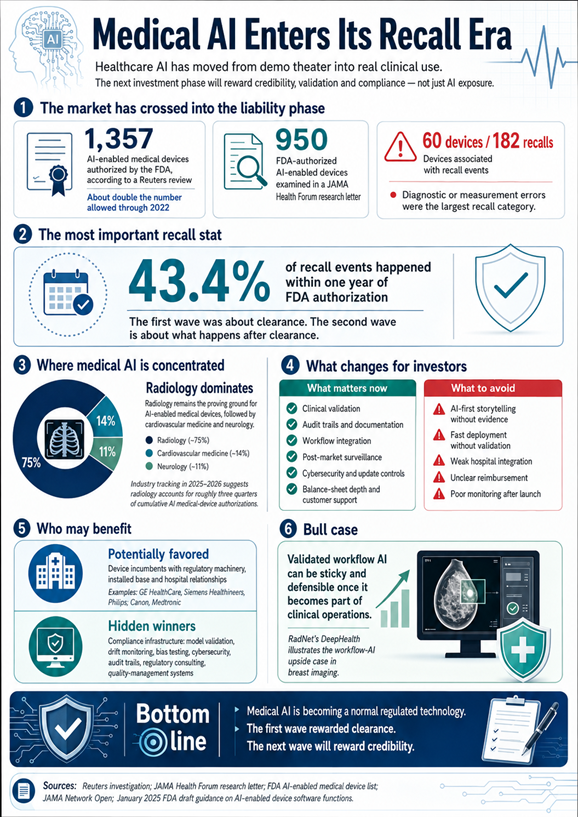
That question is becoming urgent. A recent Reuters investigation1 found that at least 1,357 medical devices using AI are now authorized by the FDA. That’s double the number allowed through 2022.
Reuters also reviewed adverse-event and malfunction reports involving AI-enhanced devices — including surgical navigation, fetal ultrasound and cardiac monitoring systems. The manufacturers and regulators involved have not treated every allegation as proven, and the FDA cautions that adverse-event reports alone cannot assign blame.
But investors do not need a final courtroom verdict to see the shape of the risk: Medical AI has crossed into the liability phase.
The cleanest data point comes from a JAMA Health Forum research letter.2 Researchers examined 950 FDA-authorized AI-enabled medical devices and found that 60 devices were associated with 182 recall events.
Diagnostic or measurement errors accounted for the largest recall category; 43.4% of recall events happened within a year of FDA authorization.
That is the number investors should sit with. The first wave of medical AI was about clearance. The second wave will be about what happens after clearance.
This is not an argument that medical AI is a failed technology. It is an argument that medical AI is becoming a normal, regulated technology.
That is a very different thing.
The FDA List Is No Longer a Curiosity
The FDA’s own AI-enabled medical device list3 says it is intended to identify AI-enabled devices authorized for marketing in the U.S. and improve transparency for providers, patients and developers. More importantly, the agency also warns that the list is not comprehensive and that public summaries do not include all submitted information.
That caveat matters, as investors often treat FDA authorization as a finish line.
For adaptive, data-dependent software used in clinical workflows, it is closer to a starting gate.
As stated above, the FDA’s number sits near 1,357 devices approved as of September 2025. More recent industry tracking from The Imaging Wire4 puts the FDA’s cumulative AI-enabled medical device authorizations at 1,524, with radiology accounting for roughly three quarters of the total.
Even if one sticks to the FDA’s official list rather than third-party counts, the pattern is clear …
AI medicine is already a scaled medical-device market, not a speculative science project.
RadNet and DeepHealth Show the Upside Case
RadNet’s DeepHealth gives investors a more direct view of how AI can become workflow, not just software. And the upside case is not hard to see.
GE HealthCare and DeepHealth expanded their mammography collaboration in April 20265 to broaden access to AI-powered breast-cancer screening tools. That matters because breast imaging is one of the places where AI can be tied to measurable operational outcomes: reading efficiency, second-review workflows, detection support, case prioritization and network-level standardization.
That is not the bullish, futuristic version of medical AI you may have heard in headlines or TED talks that has fueled the AI bubble so far. We’re not talking about AI chatbots replacing doctors.
Instead, this is a regulated tool sitting inside a repeatable clinical workflow where performance can be measured.
There is still risk in this more measured AI application. Namely that every new deployment increases the need for validation and monitoring.
But the key for investors is where the opportunity now lies. And that’s in the fact that validated workflow AI — as we’re seeing emerge in medical care — may be more defensible than generic AI software.
As I said, these aren’t “cool to use tools.” If they improve quality of care and become part of clinical opera and treatment, medical AI will be harder to rip out of the market.
The Investment Question Is Changing
The old investor question was simple: Who has AI exposure?
The new question is harder: Whose AI exposure can survive scrutiny?
In medicine, an algorithm does not just need to improve workflow in a demo. It needs to work across messy hospitals, different scanners, different patient populations, different operators, software updates, cybersecurity threats and real-world edge cases.
It also needs to leave a paper trail that hospitals, insurers, lawyers and regulators can trust.
That shifts the advantage away from “AI-first” storytelling and toward boring strengths. In other words, the medical-AI safety cycle may favor incumbents more than the market currently appreciates.
That’s not to say companies like GE HealthCare (GEHC), Siemens Healthineers (SEMHF), Philips, Canon (CAJFF), Medtronic (MDT) and other device incumbents are risk-free. Just that they have the regulatory machinery, hospital relationships and field-service networks that small software vendors often lack.
In a recall era, those advantages matter. It means the big players are the ones who can afford to take the risk of implementation.
The Hidden Winners
The most interesting investment implication may sit one layer below the obvious AI-device names.
Like with much of AI, investors should look at the infrastructure level. Specifically, compliance infrastructure.
The FDA’s January 2025 draft guidance on AI-enabled device software functions6 emphasizes documentation, risk management and the “total product life cycle.”
That phrase is the tell. The regulator is not only asking what the model does at submission. It is asking how the product is designed, tested, updated, monitored and controlled over time.
That creates demand for a lot of oversight, including …
- model validation,
- bias testing,
- drift monitoring,
- cybersecurity,
- clinical evidence generation,
- audit trails,
- quality-management systems,
- regulatory consulting
- And hospital AI governance.
Some of that revenue will accrue to device makers. Some will accrue to healthcare IT vendors, cloud platforms, cybersecurity providers, data vendors and specialist compliance firms.
The market is not yet great at pricing this layer because it is not as photogenic as an AI doctor. But it may be where the steadier money lands.
What to Avoid
The names to avoid are the ones selling medical AI as if healthcare were consumer software.
In this market, speed is not always a virtue.
A company that rushes deployment without clinical validation, reimbursement clarity, hospital integration or post-market monitoring may win headlines. But there’s no guarantee it’ll win durable revenue.
Worse, it may turn AI exposure from a valuation premium into a valuation discount.
That is the crucial distinction for investors. The strongest companies will be able to show evidence that their products improve care or efficiency without creating unacceptable operational and legal risk.
The weakest companies will offer demos, press releases and vague claims about transformation.
Bottom Line
Medical AI is entering its recall era. That sounds bearish, but it does not have to be. Recalls, liability and regulation are often the price a technology pays for becoming real.
The companies that survive this era will be the ones using AI productively and responsibly, not just as a trend. The market’s job now is to separate AI that merely gets cleared … from AI that can be trusted at scale.
The first medical-AI wave rewarded clearance.
The next wave will reward credibility.
Savvy investors are already on the lookout to see who the next stage winners will be.
Best,
Jurica Dujmovic
P.S. It can be tough to sort through the mountains of data to find the right AI investment for your portfolio.
That’s where Weiss Ratings Plus can help.
This is the ultimate data-powered investing tool. It delivers real-time, unbiased financial intelligence backed by millions of daily calculations and over 53,000+ stocks, ETFs and mutual funds.
Even better, you can customize stock filters to help you pinpoint the best opportunities and make your research even easier.
2 https://jamanetwork.com/journals/jama-health-forum/fullarticle/2837802
4 https://theimagingwire.com/2026/06/17/top-10-radiology-ai-vendors-by-number-of-fda-authorizations/