Michael Saylor First Mocked Bitcoin. Now, He Owns $71 Billion of It.

 |
| By Beth Canova |
From the television to the internet to suitcases with wheels, every innovation has had its skeptics.
I remember when camera phones first came out, my mom refused to get one. “Who needs that? I already have a camera,” she said.
Based on the daily pictures she sends me of her garden, it’s safe to say she’s come around.
Fortunately for mom, her skepticism was shared in private.
But Michael Saylor said his version in public. In writing. On the internet. And you can still read it today.
Which adds to the irony that, seven years later, he’s now the biggest corporate buyer of the very thing he mocked.
His story is not about getting in early. He didn't. It is about what made a skeptic change his mind, and why being late to an idea is not the same as being wrong about it.
The Tweet He Forgot He Wrote
In December 2013, Saylor was a well-known tech CEO with a big following. He ran the software company then known as MicroStrategy, now just Strategy (MSTR).
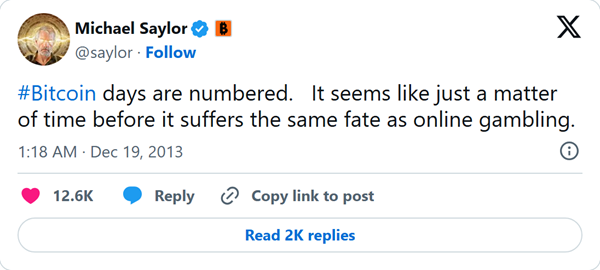
That’s when he made the following tweet: "#Bitcoin days are numbered. It seems like just a matter of time before it suffers the same fate as online gambling."
Bitcoin (BTC) is digital money that no bank or government controls. There will only ever be 21 million coins. That cap is written into its code.
And at the time, he had reason to be wary of hype. In March 2000, his own firm told the market it had to redo two years of results. Its stock fell from $260 to $86 in a single day. The SEC later charged him over the books, and he settled without admitting or denying the claims.
Fortune put his paper loss that day at about $6 billion.
He knew what a bubble felt like. So, he waved Bitcoin off.
Years later, a podcast host asked him about that tweet. His blunt answer: "I literally forgot I ever said that."
The Ice Cube That Changed His Mind
What moved him was not a price chart.
It was cash.
In 2020, MicroStrategy had about half a billion dollars sitting in its treasury. Many firms park cash like that in short-term Treasury bills and forget about it.
But then COVID hit. The Federal Reserve and Congress poured huge sums into the system.
And Saylor did the math on what that could do to the dollar over time.
His words: "We just had the awful realization that we were sitting on top of a $500 million ice cube that's melting."
Anyone who has watched prices at the grocery store gets that line. Cash that earns less than inflation shrinks a little every year.
So, on Aug. 11, 2020, MicroStrategy bought 21,454 BTC for $250 million. That works out to about $11,650 a coin.
The press release called it "digital gold."
The day a public company put bitcoin in its treasury: 21,454 coins for $250 million. Source: MicroStrategy press release filed with the SEC, August 11, 2020.
Notice the timing. Bitcoin was 11 years old by then. It had crashed more than once. Saylor was not early. He was a late convert who finally saw a problem bitcoin could solve for him.
From 1 Buy to 4% of All BTC
A lot has changed since that first buy. Even the company’s name.
But what hasn’t changed is Strategy’s belief in Bitcoin. It still buys almost every week. On Oct. 13, it told the SEC it had bought another 250 BTC.
That brought its total to 848,250 BTC, the most it has ever held.
That is about 40 times what it bought in 2020. It is also roughly 4% of all the Bitcoin that will ever exist.
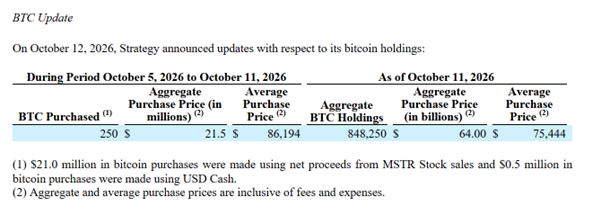
At about $83,600 a coin, that stake is worth around $71 billion. Strategy paid $64.0 billion for it. Bitcoin as a whole is worth about $1.7 trillion.
The Hard Part of the Story
None of this has been a smooth ride. And the rough parts may teach you the most.
Bitcoin is down about 26% from a year ago. It peaked near $126,000 last October.
Strategy's stock took it much harder. By late June, MSTR was about 85% below its November 2024 high.
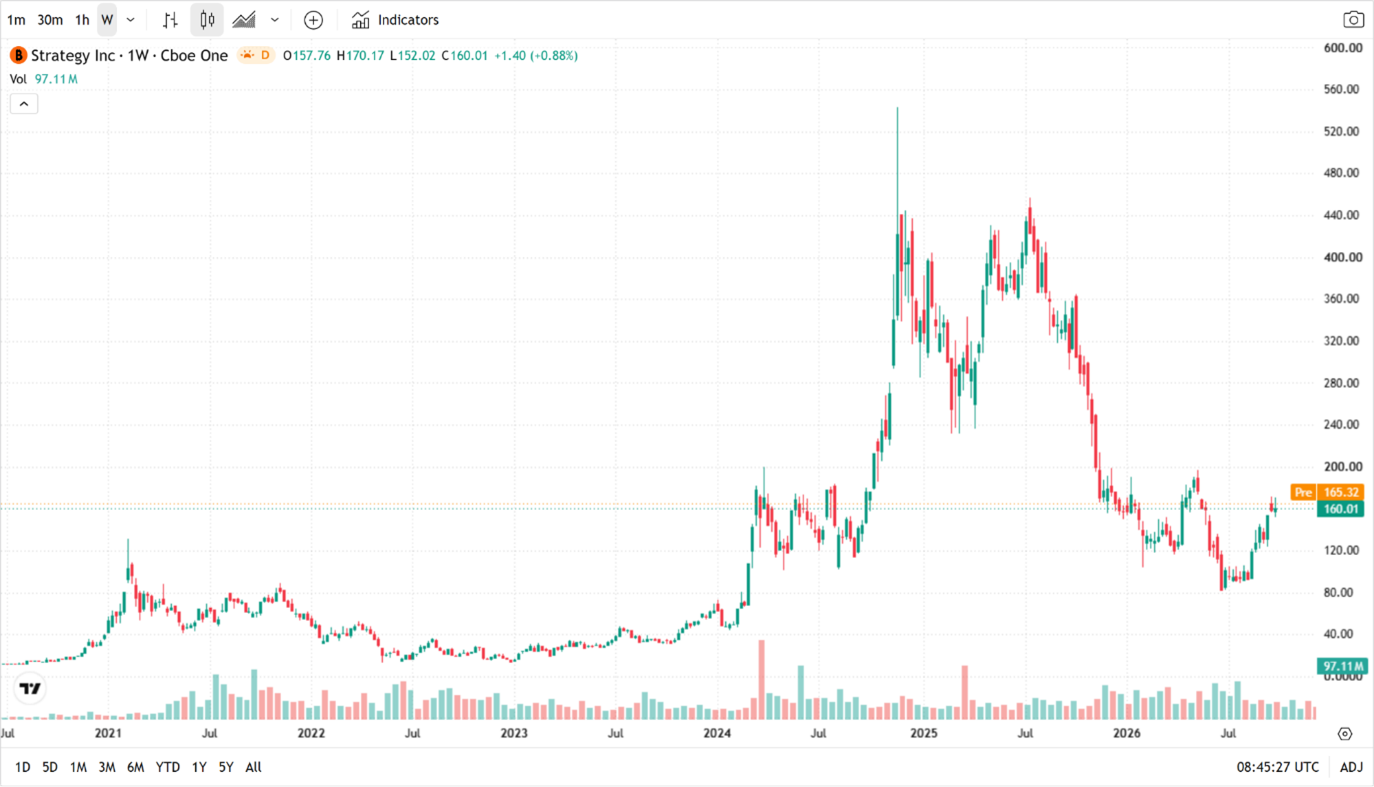
Then came a twist: Between late May and early August, Strategy sold about 6,900 Bitcoin, in part to pay dividends on its preferred stock. Some of it went for around $60,000 a coin, well below what the firm paid on average.
It has since been brought back to a new high. But the lesson stands.
Even the most famous Bitcoin buyer on earth has had to sell some.
3 Ways to Own Bitcoin Like Saylor
You don't need to run a company to hold what Saylor holds.
There are three main ways to build your own Bitcoin holdings. Each with its own strengths and considerations …
1. A spot Bitcoin ETF. For most readers, this is the simplest path. A spot ETF holds real BTC, and you buy its shares like any stock. It can sit in an IRA next to your index funds.
The two biggest names are the iShares Bitcoin Trust (IBIT), run by BlackRock (BLK), and the Fidelity Wise Origin Bitcoin Fund (FBTC).
Each charges a yearly fee of 0.25%. That is $25 a year on every $10,000. IBIT alone held about $66.9 billion as of Oct. 13.
The catch: You own shares of a fund, not the coins. You can't move them or spend them. And the fund trades only when the stock market is open … even as Bitcoin continues to trade nights and weekends.
2. The coin itself. You can buy Bitcoin on an exchange such as Coinbase (COIN). There is no yearly fund fee. And if you move the coins to a device you control, no firm stands between you and your money.
The catch: If you store your BTC on Coinbase, you have to trust the platform will keep your crypto secure. Or make you whole if a hack happens.
Alternatively, you can move your crypto to a self-custody wallet. With this move, you become your own bank. Lose the password, and no help desk can get it back.
(You can check out Juan Villaverde’s recent take on how to store your crypto here.)
3. Strategy's stock. Some investors buy MSTR as a leveraged BTC play. And it does move with Bitcoin … but with bigger swings in both directions.
There are two reasons.
First, the stock's price can sit well above or below the value of its BTC. Think of a closed-end fund that trades at a premium or a discount to what it holds. In late June, the market valued the whole firm at less than its BTC holdings.
Second, Strategy borrows to buy. As of June 30, it owed about $6.7 billion in debt. It also had about $15.5 billion of preferred stock, which gets paid before common shareholders. From Sept. 28 to Oct. 4 alone, it spent $142.5 million on dividends and interest.
That is leverage. It is why BTC fell about half from its peak by late June, while MSTR fell 85%.
How Much Is Enough?
Saylor bet his company.
But you shouldn’t bet your retirement. And according to BlackRock, you don’t have to.
When its research team ran the numbers in December 2024, they called 1% to 2% of a stock-and-bond portfolio "a reasonable range."
The caveat, however, is that investors will need to hold through "rapid price plunges."
At that size, BlackRock said, BTC adds about as much risk as one big tech stock — like Apple (AAPL) or Nvidia (NVDA).
Past 2%, though, and the risk climbs fast.
On a $500,000 portfolio, 1% would be $5,000. If BTC fell by half, you would lose $2,500. That’s a noticeable hit … but not one that would wreck your overall strategy.
The Lesson in His Timeline
Saylor mocked BTC in public.
Seven years later, he’s now the crypto’s biggest corporate buyer.
Here’s the lesson I want you to walk away with: You’re not too late to this party.
It’s ok if you’ve spent the past few years trying to make sense of Bitcoin and the broader crypto market.
You are right on Saylor's schedule.
Now, it’s time to take note of his approach, as well. Because how he changed his mind is just as important.
He did not chase a price. Or hype. He started with a problem he could name. Then, he asked whether Bitcoin could solve it.
Before you put in a dollar, run his test:
1. Name the problem. His was that his cash was losing value. If you can't name yours, you are chasing a price.
2. Pick the wrapper that fits. An ETF in an IRA for ease. The coin itself for full control. MSTR only if you want the extra swing and accept the debt.
3. Size it to survive. Could you hold through a drop the way Strategy did with the 85% dip its own stock took?
If not, go smaller.
If you can't check all three, keep learning.
That is not falling behind. That’s following in the steps of how the most famous convert in crypto did it.
Best,
Beth Canova
P.S. Knowing what to buy is only part of an investor’s calculation. When to buy is just as important.
That’s why Juan Villaverde built his Crypto Timing Model. It uses key levels to determine the right time to enter and exit positions. And his long-term investors have used it to go for several rounds of gains.
With Juan’s latest analysis showing a solid buy opportunity as we wrap up 2026, his model will be on the lookout for the next chance to load up.