
 |
| By Mark Gough |
For years, the crypto industry has repeated a simple message:
Not your keys, not your crypto.
Simply put, that means if you don’t have complete control (and custody) of your assets, you don’t really own them.
Bitcoin (BTC, “B+”) challenged the traditional banking system by allowing individuals to take custody of their own wealth. Ethereum (ETH, “B+”) expanded that idea into programmable assets. And the broader blockchain industry has spent the past decade building decentralized alternatives to finance, storage, identity and computing.
Now, something remarkable is happening.
That same philosophy that led to crypto’s success is beginning to emerge in artificial intelligence.
This week, Palantir (PLTR) released a fascinating paper titled “Institutional Sovereignty in the Age of AI.” 1 At first glance, it reads like an enterprise technology white paper. But beneath the technical language lies a much bigger idea that investors should be paying attention to.
AI’s Biggest Problem Isn’t Intelligence
It’s ownership.
For the past two years, investors have focused almost exclusively on AI chips. Companies like Nvidia (NVDA) have dominated headlines, and rightly so.
But infrastructure evolves.
Cloud computing eventually became about software. The internet became about platforms.
So, the forward-looking among us are now asking: What will AI be about?
Today, millions of employees interact with AI every day. They upload documents, write software, analyze financial reports, review legal contracts and ask AI to solve increasingly complex business problems.
Every interaction creates value. But where does that value live?
Palantir argues that companies should treat their internal knowledge as one of their most valuable assets. That means steps should be taken to avoid allowing it to become part of someone else’s competitive advantage.
The paper repeatedly stresses the importance of Zero Data Retention (ZDR), ensuring prompts and outputs are not stored or reused for future model training.
That immediately reminded me of crypto’s core principle. Of “not your keys, not your crypto.”
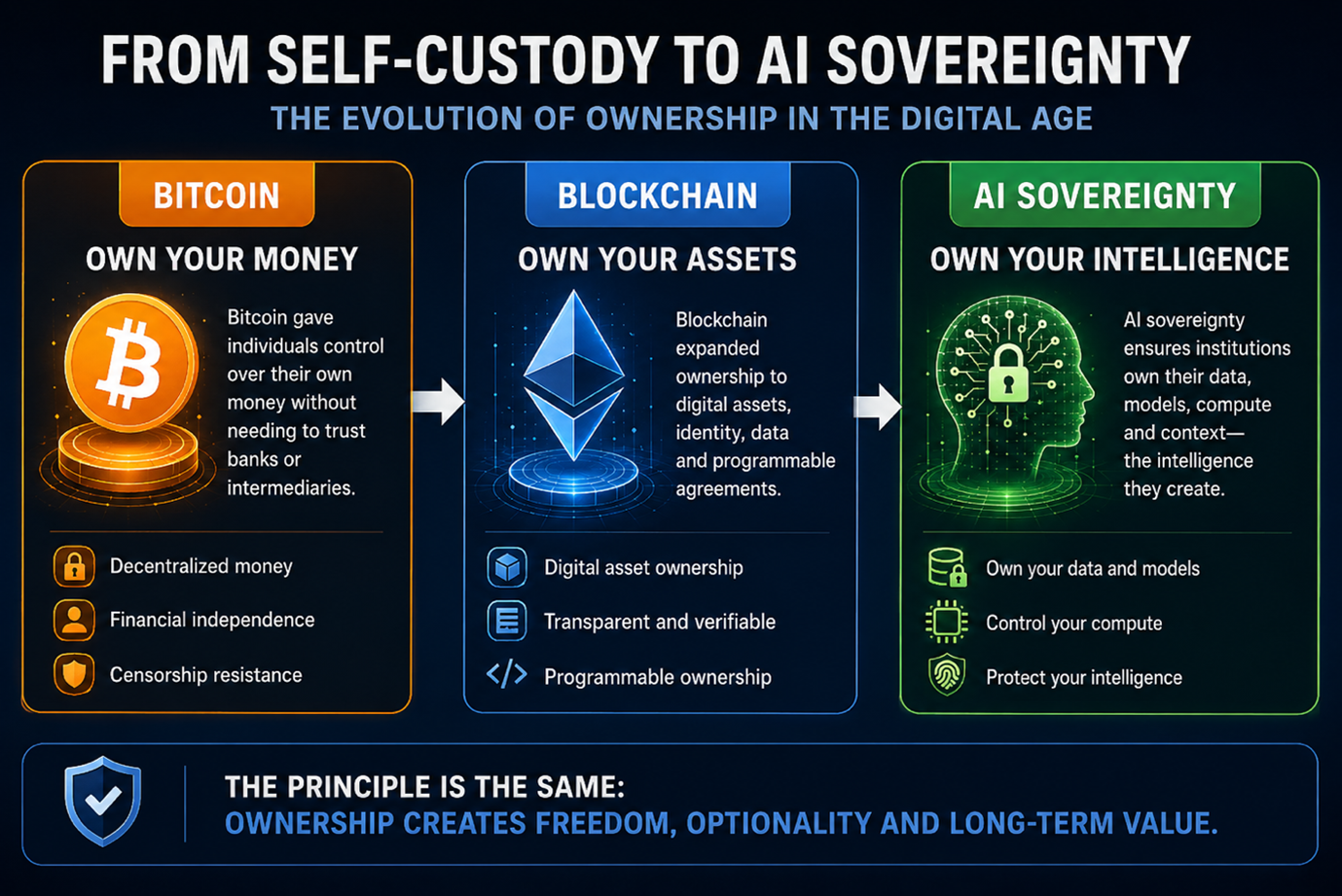
Perhaps AI’s version will become: Not your data, not your intelligence.
This Sounds Surprisingly Familiar
Crypto has always been about removing unnecessary trust.
- Instead of trusting banks, you verify transactions yourself.
- Instead of relying on central intermediaries, you own your private keys.
- Instead of assuming records are accurate, blockchains provide a transparent ledger that anyone can verify.
Palantir’s vision follows a remarkably similar philosophy.
Rather than relying entirely on a single AI provider, the paper argues that institutions should remain flexible. They should maintain the ability to switch between models while retaining ownership of their data, workflows and institutional knowledge.
That isn’t just good technology design. It’s good business.
History has shown that companies rarely benefit from becoming dependent on a single platform provider.
Why This Matters for Crypto Investors
Most investors still view AI and crypto as separate themes.
I think that’s a mistake.
That’s because, if enterprises increasingly demand AI sovereignty, blockchain infrastructure could become one of the technologies that makes it possible.
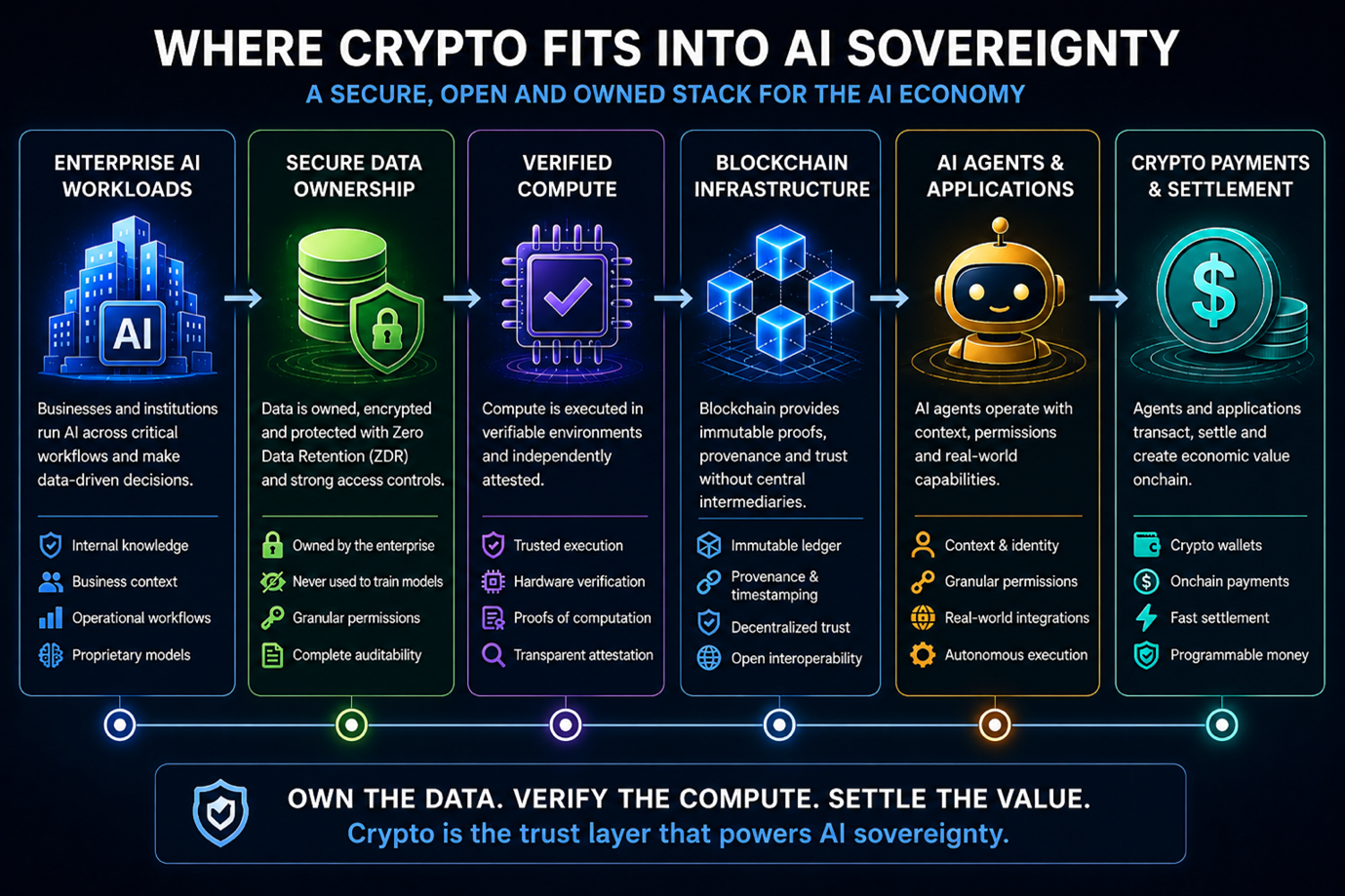
And that means several emerging crypto sectors would suddenly become much more interesting.
The first being decentralized compute.
Training and running AI models requires enormous computing power.
Projects like Render (RENDER, “B-”), Akash Network (AKT, “D”), and io.net (IO, “D”) are attempting to build decentralized compute networks that reduce reliance on traditional cloud providers.
Ideally, that would make the power behind AI cheaper.
The second sector is verifiable AI.
If a business want proof that AI workloads were executed securely, blockchain technology can offer an immutable record of what happened and when. That aligns closely with Palantir’s emphasis on verifying compute rather than simply trusting third-party infrastructure.
The third sector is data ownership.
AI models are only as valuable as the data they learn from.
Projects focused on decentralized storage, data provenance and secure data sharing could become increasingly important as businesses seek to protect proprietary information.
This is one reason I’ve continued to follow projects such as Space and Time (SXT, “E+”), which sits at the intersection of blockchain, data verification and enterprise analytics.
That’s not to say all three sectors will see the same type of attention. Or that I believe all the projects I listed will see this narrative impact their tokens’ prices.
But it is becoming increasingly clear that AI faces problems crypto tech can solve. So for savvy investors, the projects at the forefront of those answers are a solid place to start your research for your next AI play.
The fourth sector is AI agents.
While overlooked in mainstream media, the crypto community has been buzzing about the possibility that AI agents may become incredibly capable for a while.
To do that, these autonomous AI programs need a way to own assets, make payments, verify identity and settle transactions.
Traditional banking infrastructure wasn’t designed for autonomous software. But blockchain networks were.
As AI agents become more sophisticated, crypto wallets and blockchain settlement could become as essential to AI as payment networks are to e-commerce today.
Final Thoughts
Palantir never set out to write a crypto paper. Yet many of its core arguments echo principles that have underpinned blockchain technology since Bitcoin first appeared.
- Ownership matters.
- Verification matters.
- Reducing reliance on trusted intermediaries matters.
The difference is that this time the discussion isn’t about digital money. It’s about digital intelligence.
If AI truly becomes the defining technology of the next decade, then AI sovereignty could become one of its most important investment themes.
And if that happens, the line between artificial intelligence and blockchain infrastructure may become far thinner than most investors realize.
That means there will be even more ways to get AI exposure into your portfolio. Either with a Bet on the Gatekeepers Shaping the AI Agent Marketplace or in the crypto projects poised to bring blockchain solutions to corporate AI.
Best,
Mark Gough