|
Key Takeaways
|
 |
| By Jim Nelson |
The market is fearful. And for good reason …
With the resignation and rehiring of Jensen Huang, the credit crisis at the neoclouds and the sharp backlash from voters over data centers, AI is no longer as hot as it was a few months ago.
Every day feels like a new up or down on the roller coaster.
That’s one reason why the volatility index, or VIX, spiked to its highest point of the past year recently.
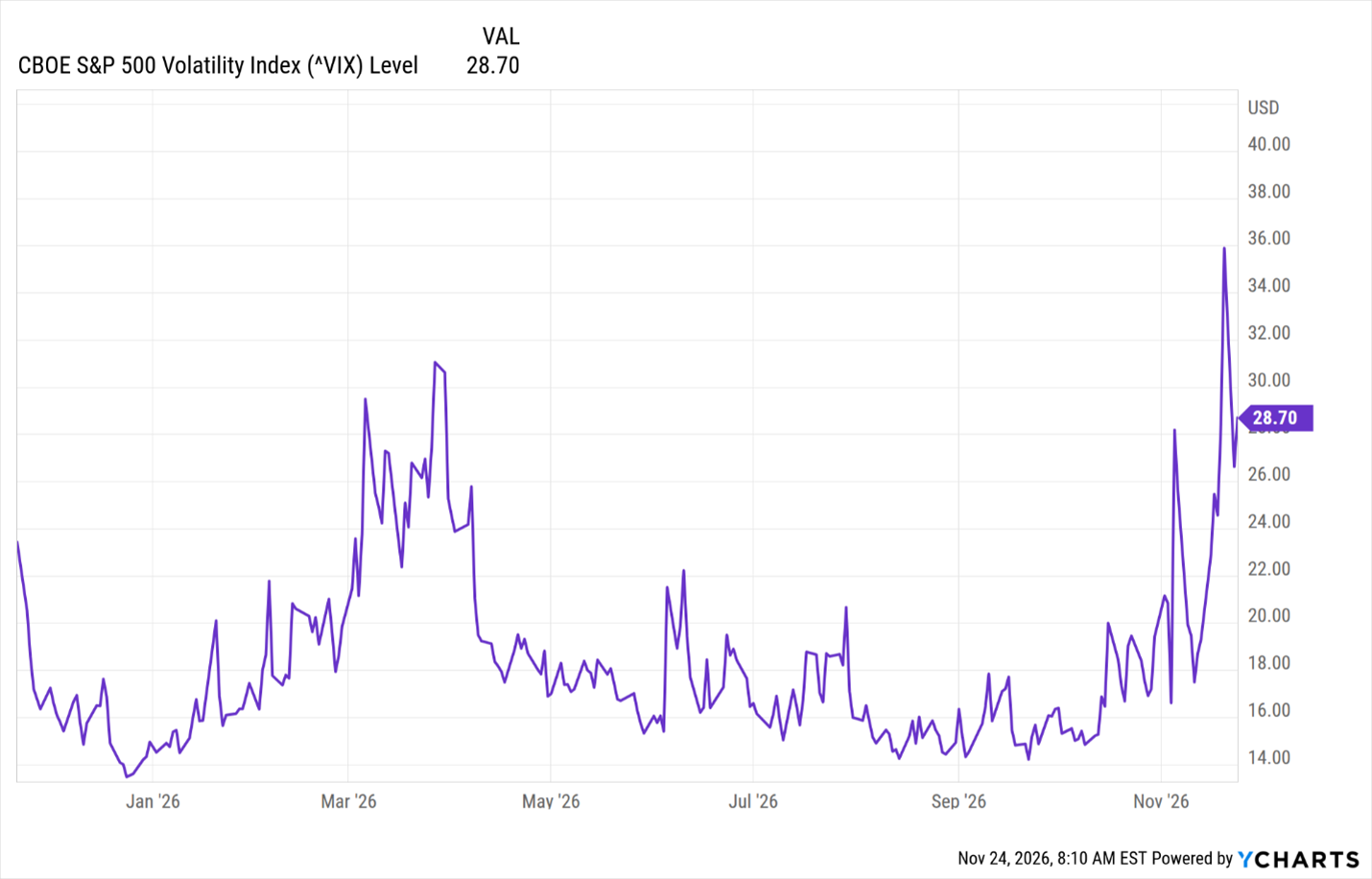
It’s also why CNN’s Fear & Greed Index has been in “Extreme Fear” mode for the past month:
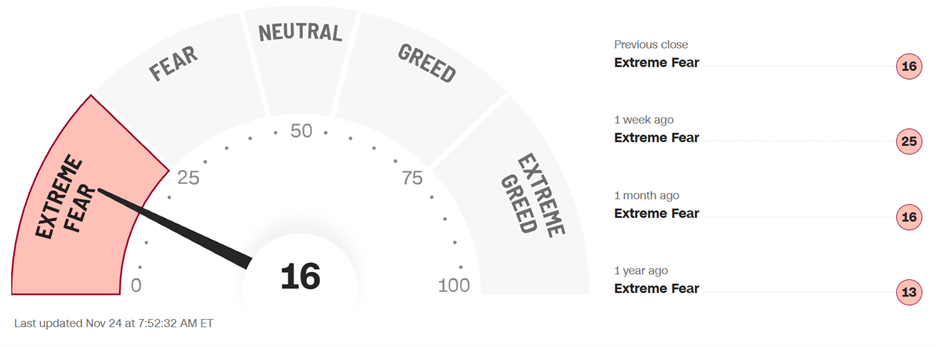
With the market in flux … and AI stocks at the center of it … many are turning toward defensive-oriented investments.
That typically means fixed-income investments like bonds and bank CDs.
It also means dividend-paying equities.
There’s just one problem …
Income stocks have never been this stingy with their payouts.
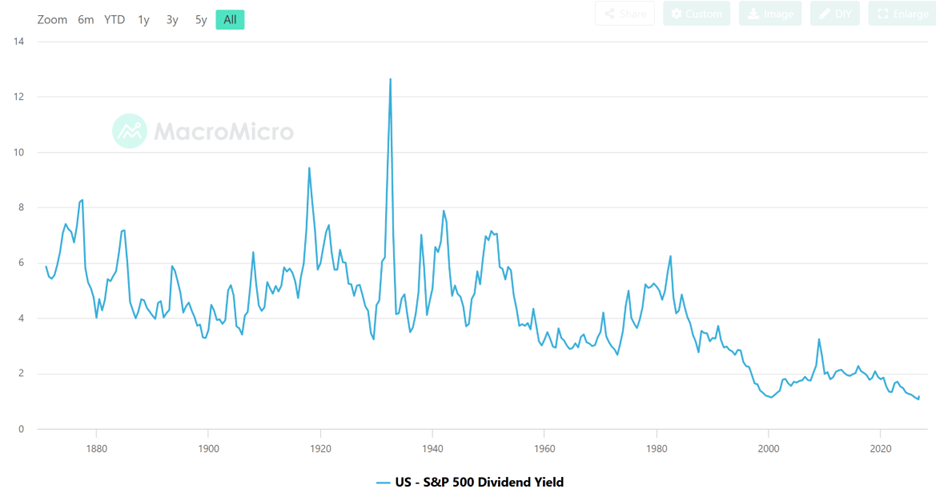
The average stock in the S&P 500 pays just 1.06%. With inflation well above 3%, that’s a money-losing proposition.
And while many fixed-income investments pay more than today’s inflation, they come with their own problem — they are fixed.
So, inflation will eventually eat into those yields over time, too.
That doesn’t mean you are out of options.
As Nilus Mattive noted this morning, I bonds can give you a guaranteed yield above inflation, tied to inflation.
And not all dividend payers are so stingy as the average indicates.
You can easily find high yielders with Weiss Ratings Plus.
We even have a special screener called “The Ultimate Dividend Yield List.” And you can find it with a single click.
But high yield does not necessarily mean good yield.
There are often reasons why a stock is showing a dividend yield above 10%.
I’ll cover these first.
Then, I’ll show you how to avoid the pitfalls to find your own safe dividend stocks.
How to Judge Dividend Health
For most companies, dividends are not mandatory.
There are exceptions, like real estate investment trusts, master limited partnerships and business development companies.
But since most companies are not those things, their boards can decide on their policy.
So, in theory, proper corporate governance would oversee the ability to pay the dividend going forward.
If a company had major upcoming expenses or lots of debt coming due, the board would be smart to save cash by keeping a low-dividend policy or even its their payments.
Reality is very different.
One of the quickest ways to lose shareholders — especially those invested in a company that has historically paid a steady dividend — is to cut its payments.
Many investors, particularly of certain sectors like utilities and consumer staples, are invested primarily for dividends. So, why would they stick around if there’s a threat to future dividend payments?
Boards are aware of this and often delay dividend cuts until the last possible moment.
That’s how a hypothetical 10% dividend yield could quickly become a realized 0% yield.
The best way to see if a company might be in danger of cutting its payments is to look at something called its “payout ratio.”
That’s simply the portion of its earnings that it pays out in dividends (dividends divided by earnings).
A high one or even one that goes above 100% — meaning it pays more in dividends than it earns — indicates a problem.
However, there’s an even better way to judge the health of a dividend. Instead of earnings, use free cash flow.
Earnings tell you a company’s bottom line. They can also give off false positives.
A company could be completely healthy but have a one-time loss due to some accounting complication.
It could show a surge of income from a product launch that skews its numbers.
A more accurate way to judge a dividend’s health is to look at free cash flow, which accounts for changes in non-cash expenses and working capital.
Let’s look at two examples. One that gives you a green light to invest. The other shows risk.
Procter & Gamble (PG, “B-”) earns steady income above its costs.
Its business model is about as defensive as you can find. Its customers can’t just decide not to buy toothpaste, shampoo and laundry detergent.
So, you would expect a stable amount of free cash flow to cover its dividend … and you’d be right.
To find its free cash flow for the past 12 months, subtract its capital expenditures from its operational cash flow:
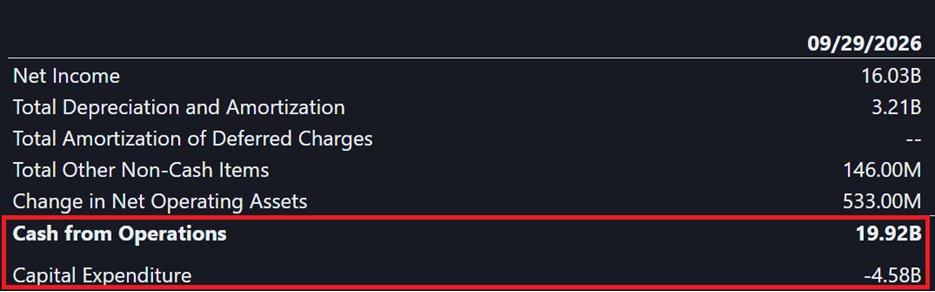
Here, you see it had $15.34 billion in free cash flow ($19.92 billion minus $4.58 billion).
A little further down its cash flow statement, it shows the company paid out $10.29 billion in dividends during the same period.

That gives it an FCF payout ratio of 67.1% ($10.29 billion divided by $15.34 billion).
That falls into the safe range. For regular corporations, anything under 70% usually means a healthy dividend.
For contrast, let’s look at a company that isn’t showing a healthy dividend: Xerox (XRX, “D-”).
The company might be almost as ancient as P&G. But its business model hasn’t been nearly as steady lately.
You can see this from its cash flow statement:
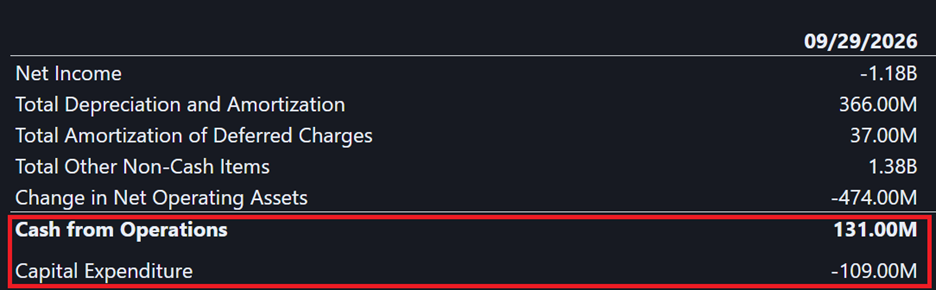

Free cash flow came in at $22 million, which doesn’t mean the company is necessarily at death’s door … at least this year.
But the $30 million in dividends it paid over the past year gives it an FCF payout ratio of 136.4%.
It pays more in dividends than it receives in free cash flow right now. That’s a recipe for disaster.
The first indicator is its 11% dividend yield.
The second, to be sure, is its out-of-whack FCF payout ratio.
This is one of the many reasons why we rate P&G a “B-” and Xerox a “D-.”
So, when you are looking for some extra income in your investment portfolio, check these three things:
- Is the company’s dividend yield too good to be true?
- How much of its free cash flow does it pay shareholders over the course of a year?
- What do our ratings say about the overall health of the company?
If the answers to those questions come back without any red flags, you should seriously consider picking up shares.
Of course, if you still want to find extra-large income, there are other ways …
In fact, right this second, Nilus Mattive is outlining three strategies that work in perfect concert to increase the amount of income you receive, the frequency you receive it and the safety of that income.
One of these strategies has only ever been shared with our top 1% of members. To see why they call it the “22x Income Secret,” watch Nilus explain it here live.
Sincerely,
Jim Nelson