Aerodrome Just Won 96.5% of Coinbase’s Tokenized Stock Trades

|
Key Takeaways
|
 |
| By Mark Gough Reviewed by: Beth Canova |
As my colleague Marija Matić pointed out yesterday, tokenized stocks are driving substantial trading activity on blockchain networks.
And that trend is only expected to grow.
In fact, she said that tomorrow’s crypto winners will likely be the projects prioritizing tokenization growth today.
That’s where I want to get specific.
Because there’s one decentralized exchange that has already secured a strong early position in this emerging market.
Coinbase Cedes Tokenization Market Share to New Competition
In August, Coinbase (COIN, D+) introduced blockchain-based versions of shares in companies including Apple (AAPL, B), Nvidia (NVDA, B), Microsoft (MSFT, B-) and Tesla (TSLA, C-).
These products are designed to represent claims on underlying shares rather than merely track their prices. Although access and trading remain subject to restrictions.
Token Terminal reports approximately $2.5 billion in cumulative decentralized trading volume for Coinbase-issued equities on Base over just the past month.
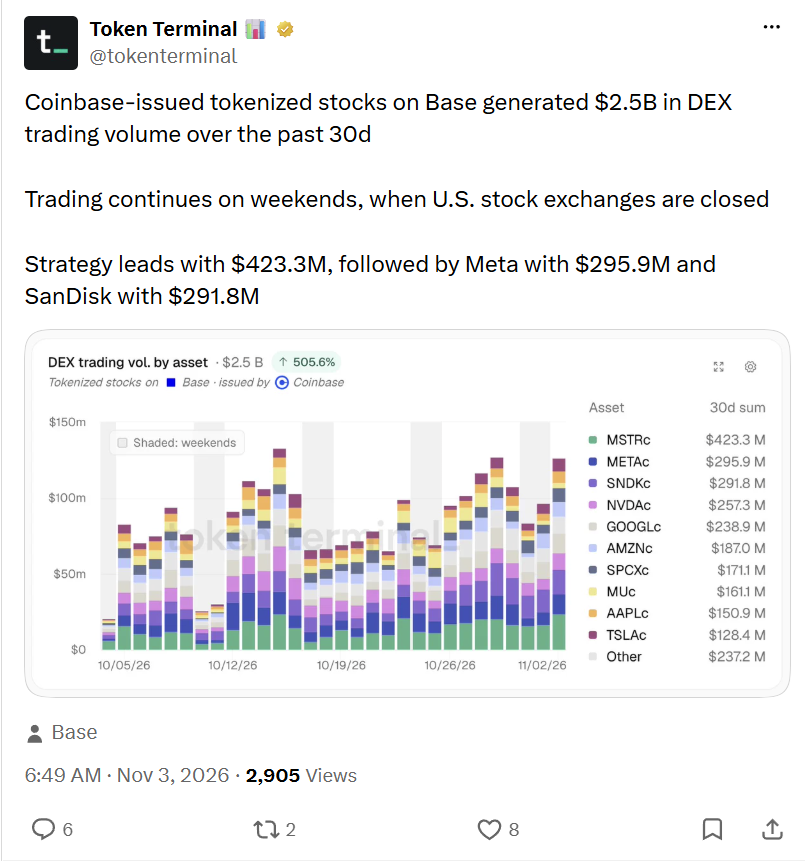
Importantly, these figures reflect actual trades on decentralized exchanges, not just tokens moving between wallets.
But Coinbase’s latest move to be the everything exchange isn’t the story. At least, not the breaking one.
Here’s what actually caught my attention …
On Oct. 21, Aerodrome Finance (AERO, D) and Velodrome merged to launch Aero, a unified decentralized exchange spanning seven blockchain networks.
And through Aero, Aerodrome handled roughly $2.16 billion of those trades. That was enough to capture 96.5% of the market for Coinbase-issued tokenized equities on Base.
That’s not 96.5% of the entire tokenized-stock market, to be clear. But it is a substantial foothold in a sector that’s still developing.
And now, Aero is looking to expand well beyond just the Base network.
With an established trading business, growing revenue and a redesigned revenue-sharing model for tokenholders, the expansion presents an interesting investment opportunity.
More importantly, it’s not happening in a vacuum. The wider market is expanding, as well.
In September, Aave (AAVE, C-) introduced lending markets that let eligible investors use certain Coinbase-issued tokenised equities as collateral to borrow USDC.
That creates another reason for investors to buy, sell and provide liquidity for these assets. As more financial instruments move onto blockchains, someone needs to provide the markets where they trade.
From 2 Networks to 7
Aerodrome built its business on Base, Coinbase’s Layer-2 networkbuilt over the Ethereum (ETH, B+) blockchain.
Its sister exchange, Velodrome, established a similar position on OP Mainnet (OP, D).
In the third quarter of 2026, Aerodrome handled 58% of decentralized exchange trading volume on Base, while Velodrome accounted for 60% on OP Mainnet.
The merger that took place just two weeks ago brings them together across seven networks — Base, Ethereum, OP Mainnet, Arbitrum (ARB, D+), Ink (INK, Not Yet Rated), Arc (ARC, Not Yet Rated) and Robinhood Chain.
That represents an estimated $120 billion in monthly decentralized trading activity.
It also introduces technology designed to make trading more efficient. Metaswaps aims to simplify cross-network transactions, while Slipstream V3 adjusts trading fees as market conditions change.
Higher fees during volatile periods may help compensate liquidity providers for taking additional risk.
The goal is to attract deeper liquidity, improve execution and win a larger share of trading activity.
The Revenue Is Already There
One reason Aero interests me is that it has an established business, not just a promise.
According to DefiLlama, the combined protocol processed roughly $17.55 billion in trades over the past 30 days.
In that same time, the platform generated $10.45 million in fees and $7.5 million in protocol revenue.
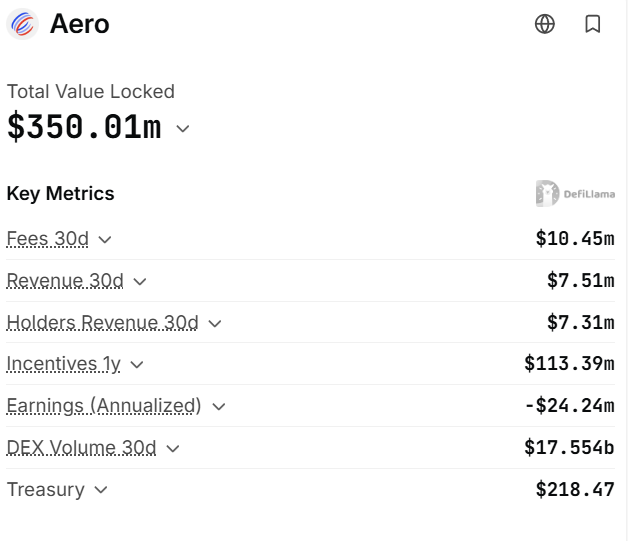
That revenue represents an annualized run rate of about $92 million, although that isn’t a forecast.
Trading activity can change, and the figures include the predecessor exchanges.
Aero also recently redesigned how tokenholders participate in that revenue: Investors can stake its native token, AERO, to receive sAERO and direct liquidity incentives toward selected trading pools.
In return, they receive a share of the revenue those pools generate.
Aero says 100% of eligible exchange revenue is allocated to staked tokenholders. That creates a closer link between business activity and token utility, which is key for potential investors.
Related Story: Crypto Discovered the Buyback. Here’s How to Read One
But rewards vary. Staking has restrictions. And simply holding unstaked AERO doesn’t provide the same distributions.
Is AERO Attractively Valued?
At the time of writing, the newly merged AERO token trades near 60 cents and carries an indicative fully diluted valuation (FDV) of around $1.3 billion.
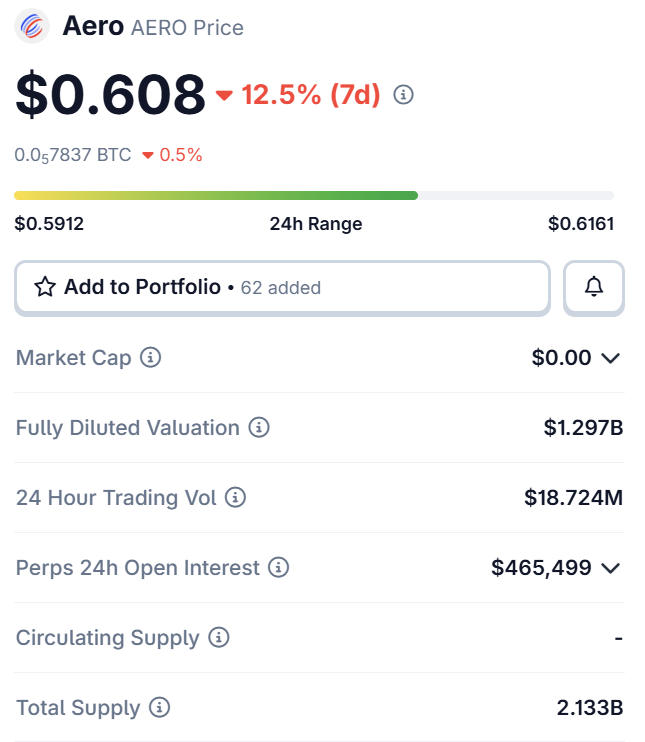
Against the protocol’s roughly $92 million annualized revenue run rate, the legacy circulating valuation implies approximately 6x revenue.
The new token’s reported FDV implies about 15x revenue.
To be clear, these aren’t price-to-earnings ratios. Protocol revenue isn’t net profit, and not all of it necessarily returns to every tokenholder.
And inflation matters, too.
Aero expects annual token issuance of around 12%, initially capped at 20%. Its incentive reforms aim to reduce unnecessary emissions by linking rewards more closely to productive liquidity pools.
Put simple, the big question is whether revenue and demand for the new AERO token can grow faster than the supply.
4 Metrics I’ll Be Watching Next
The first test is activity beyond Base, which still accounts for close to 90% of Aero’s total value locked.
The merger can only be considered successful if it can attract liquidity and meaningful trading on other networks.
I’ll also watch whether Aero retains its substantial share of Coinbase-issued tokenized-stock trading on Base as more exchanges compete for those transactions.
Third, I want to see how much additional volume translates into actual revenue. Especially since we don’t yet have a reliable breakdown of fees attributable specifically to tokenized-stock pools.
Finally, I’ll need to see staking rewards remain attractive … without the protocol printing excessive amounts of tokens to pay them off.
A Much Bigger Opportunity Ahead
Aero already…
- Processes billions in trades,
- Generates meaningful revenue,
- And is establishing a leading position in a growing segment of the tokenised-stock market.
The merger gives it a much larger market to pursue. And its revenue-sharing model creates a clearer link between trading activity and the token's economics.
Those are all checks in the “pro” column when weighing if this project should be on your watchlist.
The risks above still matter. And as with any new opportunity, caution is key.
Picking the right time to enter and appropriate size of any potential investment is critical to long-term success. As is only putting in capital you can afford to lose.
But I believe tokenized financial assets will become an increasingly important part of blockchain finance. In particular, the exchanges that provide liquidity for those assets could be among the early beneficiaries.
And Aero has already shown it can capture a meaningful share of the trading activity on one network.
The next challenge is turning that early advantage into sustained revenue growth across seven networks.
That’s what I’ll be watching over the coming months.
You should, too.
Best,
Mark Gough
P.S. When it comes to timing, there’s no one with more insight and data than my colleague Juan Villaverde. He’s made studying the cyclical nature of the crypto market — as well as other sectors — his main focus.
That led to his Crypto Timing Model. This tool has accurately called the last three long-term cycle peaks and valleys with shocking accuracy.
And now, it says the recent bear market is officially dead. Next up, your best buying opportunity for months. If not years.
Juan will lay out the details in his urgent crypto briefing on Tuesday, Nov. 10 at 2 p.m. Eastern.
It’s free to attend. Just be sure to save your spot today.