Hyperliquid Open Interest Jumps 80% as Bitcoin Falls

|
Key Takeaways
|
 |
| By Beth Canova Reviewed By: Dawn Pennington |
Bitcoin (BTC, “B+”) is down. Crypto investors are scared. And billions of dollars have left the market.
Related Story: Bitcoin’s Fear & Greed Index Hits ‘Extreme Fear’ … And That May Be Good News
But one crypto exchange seems to be ignoring the near-term trend.
Its trading business is booming. In fact, it just grew by nearly 80% in open trading positions. And it has passed three of the biggest names in crypto trading.
I'm talking about Hyperliquid (HYPE, “D”), a fast-growing decentralized exchange.
It has outperformed the broad market throughout the crypto bear market. So, it makes sense to see it respond to the recent weakness with a new wave of strength.
And it's been enough to put Hyperliquid ahead of global trading platforms Bybit, Kraken and OKX in terms of open positions.
Think about that.
While much of the crypto market has been in retreat, a blockchain-based exchange has been taking market share from some of the industry's largest firms.
But the real story goes beyond Hyperliquid’s latest push. Because this platform could tell us a lot about where the next wave of crypto growth may come from.
A Crypto Exchange Built for a New Era
Most people who trade crypto use a centralized exchange.
Think Coinbase (COIN, “D+”), Binance or Kraken.
These firms run trading platforms where you can buy and sell various cryptocurrencies. But it’s the platforms themselves that actually maintain custody of those assets, not you.
Hyperliquid takes a different path. As a decentralized exchange, it runs on its own blockchain. And users can trade through the platform while keeping control of their crypto wallets.
The goal is to let people trade without relying on a single firm to hold their funds.
That’s nothing new. But where Hyperliquid stands out is its focus on a type of trade called a perpetual futures contract.
Related Story: Trump Wants Hyperliquid in America. Kraken May Have Found the Way In
These contracts let traders bet on whether an asset's price will rise or fall. Think if it like an options contract in TradFi. But on the blockchain, there’s no expiration date.
And like options, traders can also use leverage to take on more risk for the potential of more reward when trading these contracts.
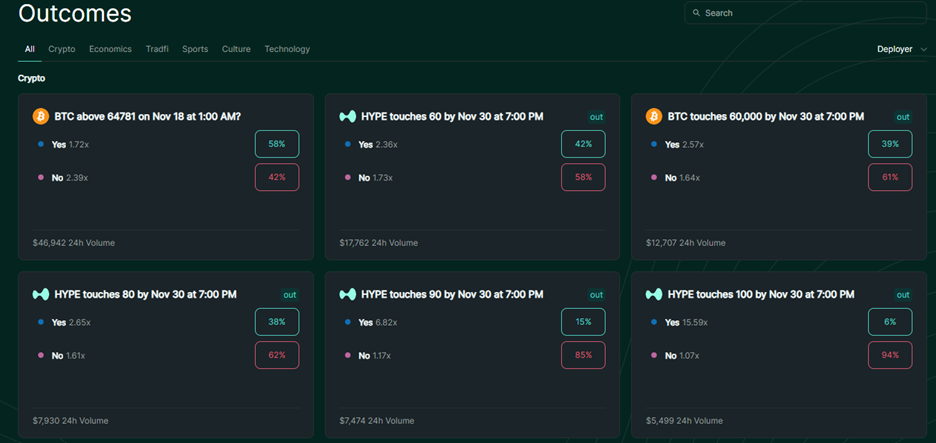
Which makes them popular with active traders. In 2025, over 70% of all on-chain activity came from perp contracts.
Now, Hyperliquid has built a fast-trading system to serve this market.
Hyperliquid's 80% Growth Stuns the Market
Open interest is the total value of futures contracts that traders still hold. It's one way to track how much activity and risk traders have on a platform.
And according to a new report from the Hyperliquid Research Collective, the exchange ended Q3 with $16.8 billion in open interest.
That’s an increase of nearly 80% from Q2.
And this wasn't the only sign of growth …
Hyperliquid's share of open interest across nine major trading venues rose from 9.6% to 11.7%.
It also saw a surge in trading volume. Monthly volume in its main perpetual futures markets rose over 70% quarter over quarter.
And the number of daily traders reached a quarterly record average of more than 65,000.
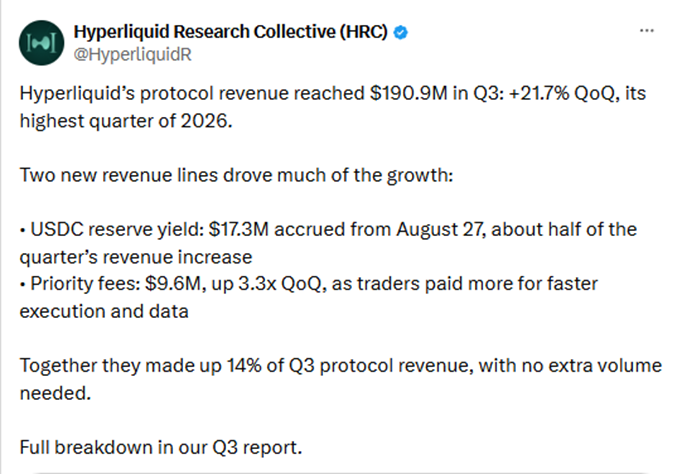
But here's the number that may matter most: Hyperliquid brought in nearly $191 million in revenue during the quarter.
That's up almost 22% from the prior quarter.
These figures cover July through September, before the latest market selloff. So, they don't prove that growth has kept up through November.
And revenue was still down from a year ago.
But the report does show something worth watching: DeFi is no longer just a niche corner of crypto.
Some decentralized platforms now have the scale to compete with major global exchanges. And Hyperliquid is pushing into an even larger market.
The Next Big Prize May Be Wall Street
With crypto adoption spreading through Wall Street, it’s easy to see where the smart money wants to flow: real-world assets, traded on the blockchain.
Centralized exchanges like Coinbase and OKX have already made moves to catch their piece of that emerging market.
Now, Hyperliquid is one of the first decentralized exchanges looking to do the same. In its own way.
Its HIP-3 system lets outside developers launch new futures markets. These markets can track assets such as stocks, gold, oil and stock indexes.
And demand is growing fast.
In the third quarter, trading volume for stock-linked perpetual contracts rose 161% to nearly $154 billion.
That's more than double the prior quarter's level. It also made stocks the largest asset class within Hyperliquid's HIP-3 markets.
Why is this a big deal?
Because it shows how blockchain trading tools could move into the much larger world of traditional finance.
And Wall Street is paying attention.
Related Story: Tokenization Got a Win. Now DeFi Needs One, Too
In late October, Intercontinental Exchange, the parent company of the New York Stock Exchange, announced a partnership with TradeXYZ.
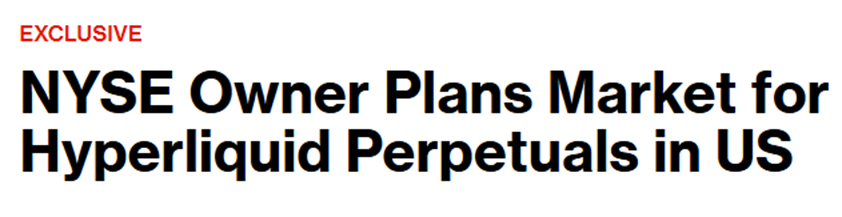
The goal is to build regulated perpetual futures markets. To do it, they’ll use Hyperliquid's technology.
The plan still needs regulatory approval. But the signal is clear.
One of the biggest firms in traditional finance sees value in this new type of trading system.
And it isn't alone.
Kraken's parent company, Payward, has also laid out plans for a regulated trading venue built on Hyperliquid's HIP-3 framework.
These plans are still in their early stages.
But they point to a much larger trend.
Blockchain technology is moving from the edges of finance toward its core.
And that shift could create new chances for investors.
What This Means for HYPE Investors
Of course, Hyperliquid has its own crypto token. And it plays a key role in the network.
It helps secure the blockchain through staking. It also gives holders a role in network governance.
But one feature stands out.
Hyperliquid uses part of the fees earned by its trading platform to buy HYPE tokens through a system known as the Assistance Fund. That creates a link between the platform's business activity and demand for its token.
As trading grows, the system may have more funds to buy HYPE.
But that doesn't mean the token's price must rise. In fact, HYPE has faced pressure despite the platform's strong growth.
And more headwinds are on the way. About 14.2 million HYPE tokens are due to unlock on Nov. 29. That could add to the supply available for trading and act as a weight on prices.
The platform also faces real risks from leverage, market swings and competition.
Hyperliquid's growth is worth watching, and its token has seen impressive 162% gain year to date. But no investment is risk free.
You’ll want to do your own research and map out a strategy before you look to load up.
The Bigger Crypto Story Is Still Strong
Here's the most important lesson from Hyperliquid's rise: Crypto prices and crypto growth are not the same thing.
Bitcoin can fall while blockchain networks gain users. Altcoins can slump while DeFi platforms take market share.
And investors can grow fearful even as major firms build new ways to use blockchain technology.
Which is why if all you do is follow the price action, you’ll always be a step behind when it comes to crypto.
And Hyperliquid gives us a clear example.
Its latest results show rising activity, new sources of revenue and growing links to traditional finance.
None of that means HYPE is set to soar tomorrow. But it does give investors a reason to keep this sector on their radar.
As the market works through its current downturn, watch for the platforms that keep winning users and building real businesses.
Those may be the ones best placed to thrive when the next crypto bull market takes hold.
Best,
Beth Canova