Tokenized Stocks Surge 395% in 30 Days as Crypto Goes Mainstream

 |
| By Beth Canova |
The biggest stock-market debut in history arrived this summer.
And for once, ordinary investors thought they had a real shot at it.
The hype was deafening. Everyone wanted in before the opening bell, and crypto exchanges promised a way to get there.
Then … the shares ran short.
Exchanges that had pre-sold tokenized SpaceX (SPCX) stock received far fewer real shares than they had promised.
Several canceled the allocations outright.
Some customers got nothing at all.
The real supply, as always, went to Wall Street first. That scramble felt like a letdown.
But zoom out, and it tells a far bigger story …
A new pipeline is forming to move U.S. stock exposure onto crypto networks. And the demand pouring into it is already too large to ignore.
What a "Tokenized Stock" Actually Is
A real-world asset, or RWA, is a traditional holding — a stock, a Treasury bond, etc. — issued as a digital token that trades on a blockchain.
On chain, these digital assets track the real stock 1:1 — just like the way an ADR lets you own a foreign company on the NYSE. You’ll also hear these RWAs called “tokenized equities.”
The difference from a normal share is the settlement layer.
A tokenized equity gives you the same exposure as the underlying share. A regulated broker holds the real stock in custody. You hold a token that represents it.
Instead of clearing through the DTCC, the token clears on crypto rails that run around the clock.
And it’s just became the fourth-largest category of real-world assets on a blockchain.
That matters to the reader who already uses Schwab or Fidelity. Those brokers match crypto on commissions and fractional shares. But not on 24-hour, weekend-included trading.
Here’s the key for crypto investors: The money chasing tokenized shares doesn’t move like crypto-native liquidity.
It moves the way institutional money moves: quietly, then all at once.
The Numbers Behind the Surge
The category was small at the start of the year. It is not small now.
Tokenized real-world assets — an umbrella term for all TradFi assets traded on-chain, including stocks, commodities, Treasurys, etc. — more than tripled year over year between 2025 and 2026 to hit nearly $487 million by the end of March 2026.
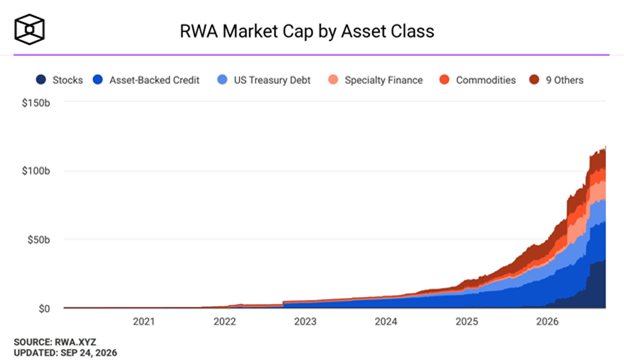
On-chain stocks specifically rose from $639 million to $3.17 billion in the past year.
That’s a 395% gain … in a year when overall decentralized finance (DeFi) use stayed under 3%!
And also makes stocks the second fastest-growing real-world asset category after tokenized private equity at 935%.
These assets aren’t just sitting idle, either. In September alone, tokenized trading volume hit a record $15.6 billion. That’s a 16% month-over-month jump.
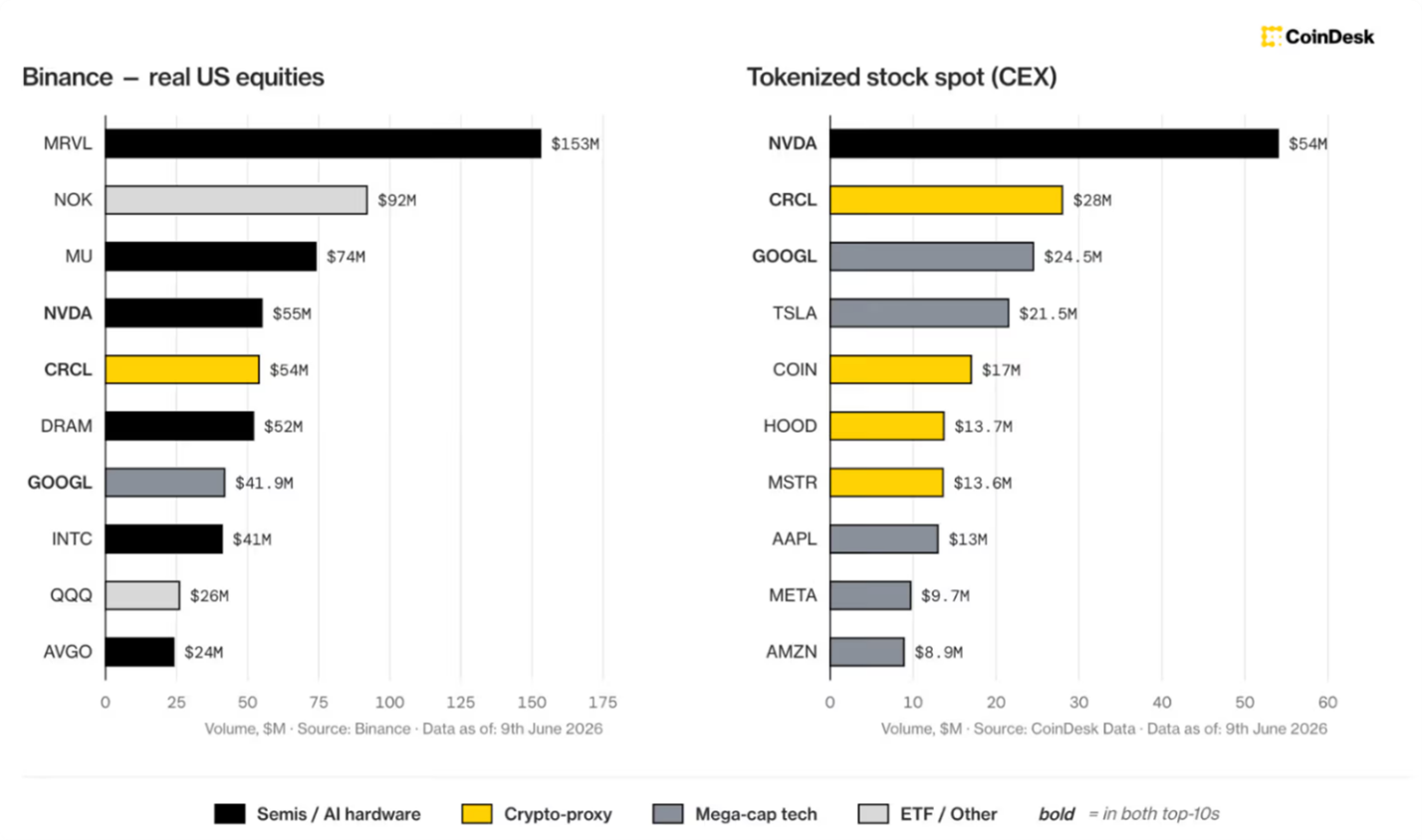
Binance — the largest centralized exchange — opened the floodgates to tokenized trading for its roughly 323 million users in two steps earlier this summer …
- On June 1, it launched trading in real U.S. shares through a regulated broker-dealer partner.
- Then, on June 11, it added a tokenized "bStocks" product, blockchain versions of those same shares.
In its first nine days, it averaged about $143 million in daily volume and crossed $1 billion in turnover. That single effort outran the entire tokenized-stock spot market; its peak weekday volume topped out near $35 to $40 million.
Binance now offers more than 7,000 U.S. stocks and ETFs, versus roughly 200 tokenized names on established competitors.
Ondo Finance (ONDO) also did its part.
It’s working with TradFi infrastructure to build out the plumbing of on-chain RWA trading. And it’s gotten institutional giants on board, rolling out three tokenized portfolios developed by BlackRock (BLK).
Why It's Happening Now
The SpaceX listing gave the demand a face.
SpaceX priced at $135 a share on June 11 and opened June 12. It closed its first day around $161. It raised about $75 billion at an implied valuation near $1.77 trillion, making it the largest IPO ever.
Retail got an unusually generous slice — roughly 30% of available shares.
Every major crypto exchange scrambled to offer SpaceX access, because their users wanted equity exposure they couldn't easily get elsewhere.
The demand is real. But so is the froth.
SPCX joined the Nasdaq-100 on July 7, an inclusion estimated to force billions in passive index-fund buying into a stock with barely 5% of its shares in public hands.
Even that couldn't lift it. The stock rose about 1% on the news, then slid to an all-time low near $145 the next day.
Forced buyers showed up. The price fell anyway.
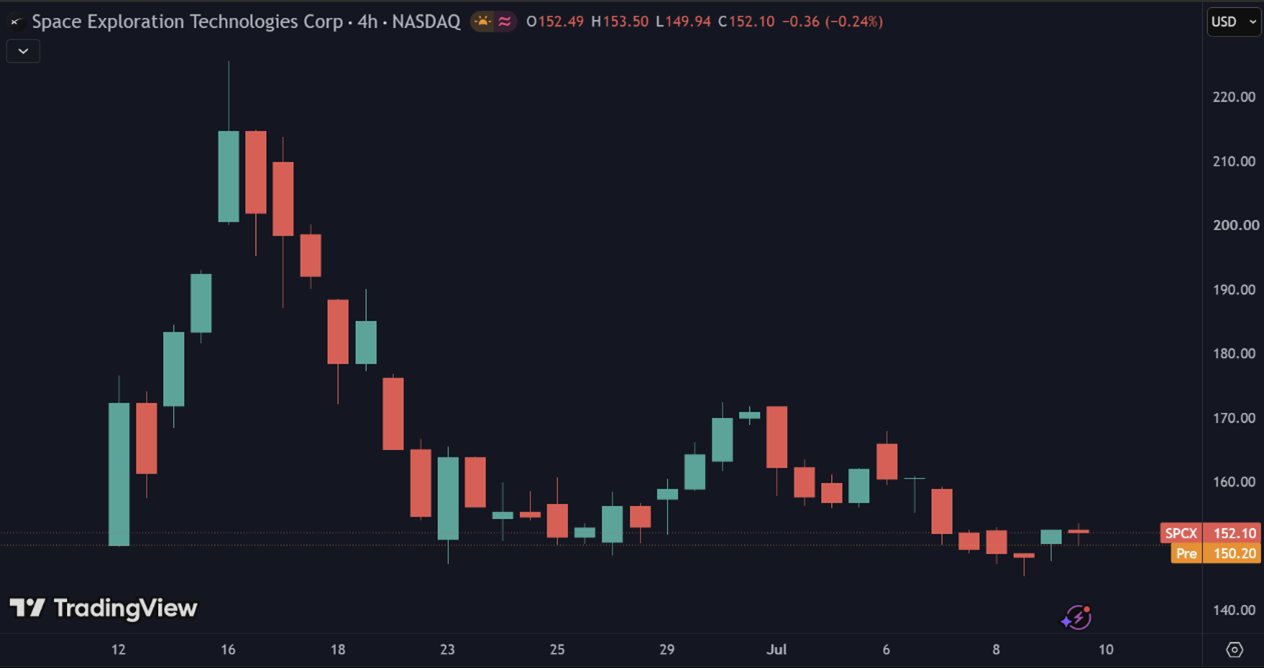
Even that couldn't lift SPCX. The stock rose about 1% on the news, then began a downward slide that continued through the end of July.
Forced buyers showed up. The price fell anyway.
The Risks Aren’t Theoretical. They’re Named
The allocation snub was the first crack: Tokenization lowers the barrier to IPO-adjacent exposure, but it does not change who gets filled first when supply runs short.
The underlying stock has been violent, too.
SPCX hit an all-time high of $225.64 on June 16, then reversed hard. It now trades near $124, down roughly 44% from that high.
And the first insider lockup expired just yesterday, releasing shares into a market that already has very little float to absorb them.
The company did post better-than-expected quarterly earnings earlier this week. That seems to have brought out some buyers, enough to push the stock up 11% in early Friday trading.
Time will tell if this momentum can continue, or if a wave of early investor selling can bring it to a halt.
A token only tracks its underlying asset. When that whipsaws, so does your exposure.
Where This Goes Next
The story isn’t SpaceX.
Weiss Ratings’ research team found that 90% of IPOs fail to reward first-day investors.
Instead, investors need to take note of the distribution channel. The fact that tokenization saw a boom as the IPO hype reached a fever pitch proved real demand in real time.
The lower-risk path for a cautious investor remains the one Wall Street already built: buy the stock, or an ETF that holds it, through the brokerage you trust.
Tokenized equities offer the same exposure. But with longer hours and rougher edges. Something familiar to crypto natives, but is tough for those familiar with set trading hours and a broker to adapt to.
This is the early plumbing of a market that wants to trade stocks the way it already trades everything else.
Best,
Beth Canova
P.S. SpaceX proved that hype alone isn’t enough for a successful IPO. And going the tokenized route wasn’t enough to give on-chain investors an edge.
Companies need a lot more going for them to land in the 10% of new listings that create value for first-day investors.
Which is why our Startup Investing Specialist, Chris Graebe, developed a new system, Apex IPO to help you target that 10%. In fact, testing showed it beat the average IPO 25-to-1.
So before you look for your next IPO opportunity, I suggest you watch Chris’ latest briefing.
This way, you’ll know what to look for … no matter if you decide to use a broker or on-chain exchange to buy.