 |
| By Jurica Dujmovic |
In July, I introduced you to AI's two gates. These are the obstacles AI needs to pass before regulated industries will let it touch any kind of real revenue ...
- The Badge Gate covers identity and revocable access for agents.
- The Indemnity Gate requires a human who can take responsibility when the work goes wrong.
I said then that the trick for investors isn’t to wait for that Goldilocks AI play. Rather, it’s to find the companies that control the gates themselves. I also called Thomson Reuters' Fiduciary-Grade AI standard what it is — a moat made of proprietary content, dressed up as trust.
Anthropic sits on the far side of both gates in that framing. That’s why it was the lab I used to illustrate the bargain: Thomson Reuters rebuilt CoCounsel around Claude.1 That moves supplies the citations, workflow and institutional cover a standalone model could not produce on its own.
But the risks I raised last week around Anthropic's IPO challenge my dual-gate theory.
Despite passing both gates, the company still faces a barrier that could prevent it from accessing real revenue for its products: regulation.
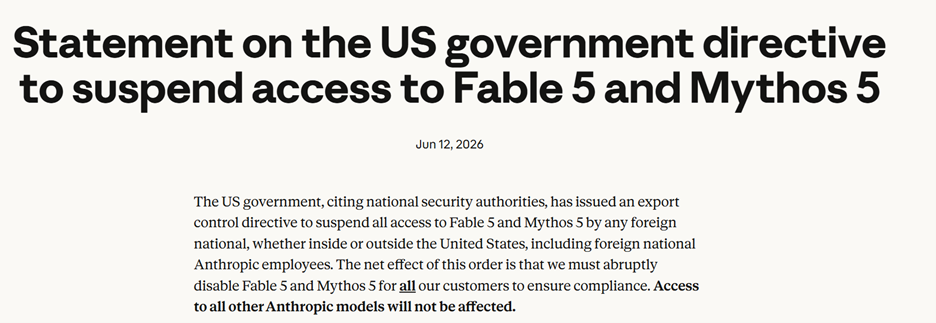
Back in June, Anthropic was forced to restrict its services to only U.S. citizens. But that layer of validation doesn’t exist in its models. So the company was forced to completely shut everyone out of two of its models — Fable and Mythos.2
The blackout lasted about 19 days in total.
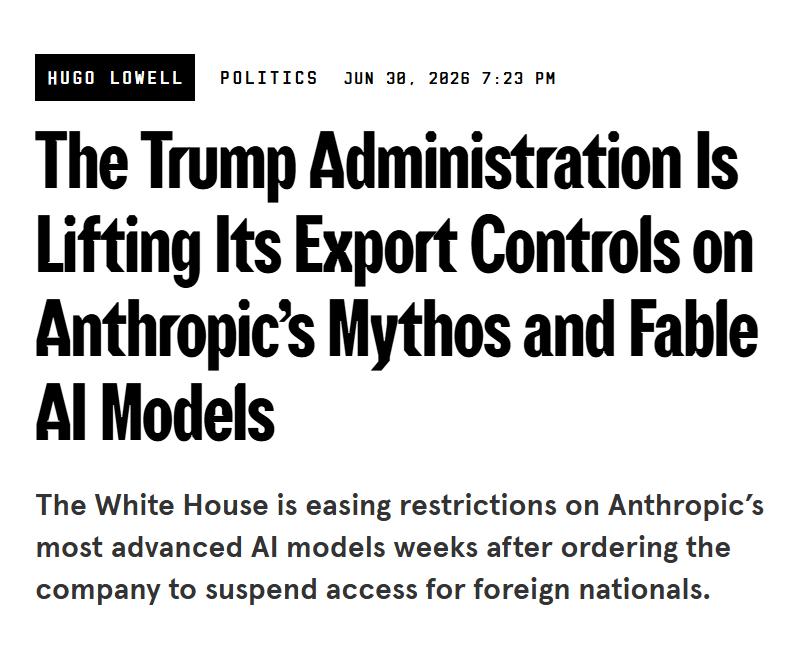
The direct impact is over. But the implications are much bigger. Because they suggest there’s now a third gate to consider.
Slipped Through the First Two Gates
The Badge Gate treats identity as the layer you can act on: Grant access, revoke it, log it.
This works for agents operating inside a company. But it fails in Anthropic’s situation because the serving stack had no reliable nationality signal. Which is why a directive aimed at foreign nationals took U.S. customers offline with them.4
The Indemnity Gate assumes someone can be held responsible.
A firm buying into an arrangement gets authoritative sources, verifiable citations, professional workflows and a counterparty large enough to sue.
What it does not get is a warranty that every answer is right. And it certainly does not get a guarantee that the model will keep being served.
Legion is the proof of the gap. It signed an agreement with Anthropic for access to its model. The blackout, it argues, violated that agreement and caused existential harm. But because the decision to kick it out wasn’t made by Anthropic itself, Legion’s only practical recourse was to sue the government.
The Department of Commerce restored access before any court ruled,5 though. So, we’re left with just legal theory, not precedent. And Legion's claimed losses unadjudicated.
Caught at AI’s New Third Gate
Anthropic was able to unlock both previously identified gates. But practically, it has not completely unlocked real AI revenue.
Roughly 80% of Anthropic's revenue comes from enterprise customers, with eight of the Fortune 10 among them.6 The bull case reads that as pricing power and stickiness, and it is.
But it’s also the size of the surface exposed to a failure no standard contemplated. One that which arrived at 5:21 p.m. Eastern.7 After a phone call that — according to Legion's legal filing — gave the company only ninety minutes to comply.
What this tells us is that the hypothesis I posed a few weeks ago has legs.
At the time, I proposed that sovereign AI — meant only for use within a specific jurisdiction under regulation — could create winners out of second-tier companies. While we haven’t seen that just yet, the road was just paved for it.
The Department of Commerce was able to halt Anthropic’s operations. As long as it can do that, it poses a risk to any company that wants to sign an agreement for access to Anthropic’s AI models. Because it means their access could get cut off at any time.
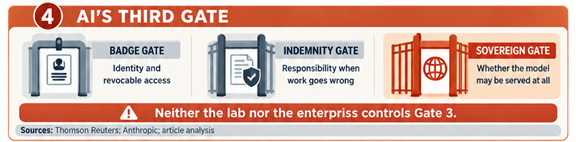
That’s the third barrier: The Sovereign Gate.
It’s the one that decides whether the model can meet the market at all. And the gatekeeper isn’t Anthropic. Nor is it the company contracting its services.
The gatekeeper is the regulatory body that can shut off operations like a tap.
The Exposure Curve Runs the Wrong Way
Anthropic’s valuation rests on a bullish 2028 revenue projection of $190 billion. But that projection itself rests on something closer to a construction schedule than a software projection:8
- Project Rainier,
- The Amazon cluster running Trainium across multiple U.S. sites,
- Access to Google TPUs,
- A Google and Broadcom deal adding 5 gigawatts of next-generation capacity in 2027,
- And $50 billion Anthropic has committed to U.S. infrastructure.
All projects announced, partly contracted and externally checkable.
Well, the capacity is checkable. The right to serve the output is not.
And the schedule is not Anthropic's alone. It all depends on Anthropic holding a growth path tied to successive frontier models — a product category Washington has now shown it is willing to interrupt.
It is the financing exposure I described last month. Just pointed at a different counterparty.
A $190 billion 2028 will not come only from today's product mix. It will lean on frontier-class systems. The kind that drew a Commerce letter within 72 hours of launch.
Think about it: The more capable the model, the better the chance someone in Washington decides it is a national security asset rather than a software product.
Capability and controllability move in opposite directions. But a revenue multiple stretched two years forward prices them as though they are unrelated.
In June the directly exposed revenue had barely begun to exist. That changes with every quarter the frontier tier stays in production.
Regulatory, Not Legal, Precedent
Commerce Secretary Howard Lutnick's June 30 letter9 told Anthropic a license was no longer required for the export, reexport or in-country transfer of the models. That included "deemed export or deemed reexport."
That phrase is the whole story.
Commerce treated remote access to a hosted model — a person sending a prompt and receiving a reply — as a deemed export of the model itself.
Harvard Law Review called the question unsettled.10
That’s true: With the case Legion brought dismissed on July 3 once access came back, no court reached the merits.
The theory was never tested. Which means we don’t have legal precedent.
What’s been established is less clear: Regulatory policy — a working mechanism, demonstrated in public — that needs no new legislation. All the Department of Commerce needs to do is send another letter and sit back.
The onus is on the recipient to contest the asserted authority after the disruption has already started.
Bottom Line
That settles an argument I made in July, when I called sovereign AI a subsidized second-place trade. I said at the time that a national champions could win on control and jurisdiction, rather than the merits of the model’s quality.
That was a projection then. It’s not now.
A European bank weighing Mistral against Claude is no longer choosing between a worse model and a better one. It is choosing between a worse model and a better one that Washington can pull from its non-American staff by letter.
Now, it now has a date to cite for precedence.
AI is poised to be one of those market-changing technologies. The emergence of this third gate could severely disrupt how investors, traders and Wall Street itself understands and values any AI investment.
Which is why I’ll be watching how the legal argument plays out very closely. I invite you to do the same.
Best,
Jurica Dujmovic
2https://www.anthropic.com/news/fable-mythos-access
4https://www.anthropic.com/news/fable-mythos-access
6https://futurumgroup.com/insights/anthropic-files-for-ipo-looking-to-beat-openai-to-the-punch/
7https://www.anthropic.com/news/fable-mythos-access
8https://www.anthropic.com/news/series-h
10https://harvardlawreview.org/blog/2026/06/is-access-to-fable-an-export/