FinCEN Drops $250 Crypto Travel Rule Plan in Privacy Win

 |
| By Beth Canova Reviewed By: Dawn Pennington |
Washington just handed crypto users another win.
On Nov. 9, federal regulators formally scrapped a plan that could have forced financial firms to collect more personal data on crypto transfers as small as $250.
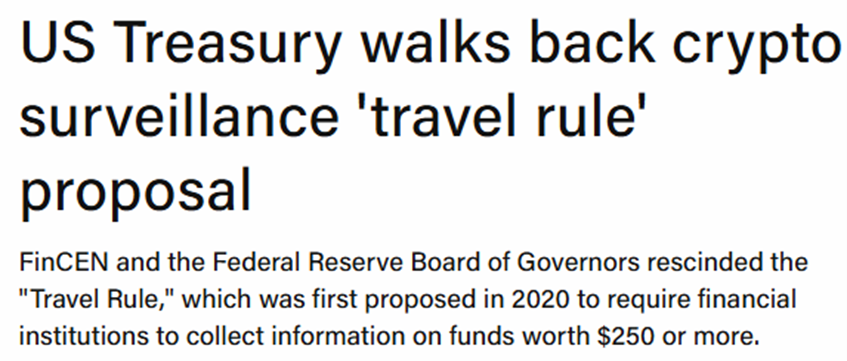
This was no one-off decision.
It follows two other crypto rule withdrawals in October, including one aimed at self-custody wallets.
Together, these moves point to a shift in how Washington plans to oversee digital assets.
But there's an important catch.
The rules investors already live with haven't gone away.
So, what has changed? And how could it shape the future of crypto?
Let's take a closer look.
What Exactly Did FinCEN Withdraw?
The story starts back in October 2020.
That's when the Financial Crimes Enforcement Network (FinCEN) and the Federal Reserve proposed new rules for how banks and other financial firms track money transfers.
The plan had two key parts.
First, it would have cut the reporting threshold for certain cross-border transfers from $3,000 to just $250.
Second, it would have made clear that the rules cover certain crypto transfers, too.
These rules are known as the Recordkeeping Rule and Travel Rule.
In simple terms, they require covered financial firms to keep and share certain details about who sends money and who gets it.
The goal is to help law enforcement track money tied to crime.
But the proposed $250 limit would have brought far more small transfers under these rules.
That could have meant more data collection, higher costs and less privacy for crypto users.
Now, that plan is off the table.
Why Did FinCEN Withdraw the Proposal?
The first reason is simple: The plan was old.
It was first put forward in 2020. And a lot has changed since then.
Crypto has grown. New firms have entered the market. And new laws have helped shape how the U.S. treats digital assets.
FinCEN and the Fed said they need to take these shifts into account before they move ahead with any new rules.
But there was another key factor.
The 2020 plan faced strong pushback.
Regulators got nearly 3,000 public comments. Many critics feared that the lower limit would put too much personal data in the hands of financial firms.
Others warned that the new rules would raise costs for banks, exchanges and payment services.
And some asked a fair question: Would tracking so many small transfers do much to stop crime?
The agencies did not say these concerns alone led to the withdrawal.
Instead, they pointed to the age of the plan and the changes in the market.
Still, the result is clear.
A broad new set of data rules will not take effect.
What Changes for Crypto Investors?
Here's the key point.
For most crypto investors, very little changes right now.
If you buy Bitcoin (BTC, “B+”) on a U.S. exchange, you still need to follow the same “know-your-customer” identity checks.
That is, you need a valid ID to set up your account.
If you sell crypto for a gain, tax rules still apply.
And if you send over $3,000 worth of crypto through a firm that falls under the Travel Rule, that firm may still need to collect and share your details with Uncle Sam.
But the withdrawal does bring three wins.
- It helps protect privacy. Though unless you use a privacy network, your transactions can still be reviewed and verified on the blockchain.
- It gives crypto firms more room to plan. That could help them avoid new costs tied to data systems and rule checks.
- Finally, it points to a wider shift in U.S. crypto policy.
This is not the first such move.
In October, FinCEN also withdrew separate proposals tied to self-hosted crypto wallets and crypto mixing.
Those plans had raised their own privacy concerns.
Clearly, regulators are taking a fresh look at older crypto rules. Something that could help build trust in the U.S. crypto market.
And make it easier for more people and firms to take part.
To be clear, Washington is not doing away with crypto oversight.
But it’s also no longer trying to regulate the market to death. Instead, lawmakers are stepping back from older plans and leaving room for a new approach.
For investors, there's no need to change how you trade or hold crypto based on this news alone.
Instead, use this as a reminder to keep regulatory and legislative updates on your radar.
Especially as we move into January … and the new Congress is sworn in.
But that’s not the only development to stay informed on.
Your Weiss Ratings crypto team found more than a few updates, many of them more immediate, you should be aware of …
Trump Jr. and Kalshi just parted ways. But the bigger story is the Nov. 18 CFTC deadline, and a way to use prediction market odds without placing a bet.
Bitcoin's 320-Day Cycle Points to a New Buy Window in 2027
What cycles expert Juan Villaverde thought was an 80-day correction may actually be a longer cycle downturn. Here’s how that changes his outlook through 2026 … and what stays the same.
Anthropic's Nov. 19 IPO Has a $104 Billion Twist
The $1.4 trillion valuation has stolen headlines, but the devil is in the details of Anthropic's revised filing. Here's what investors should watch.
AI May Need Crypto. And Wall Street Knows It
Coinbase (COIN, “D+”), stablecoins and 138 million AI payments point to a new role for crypto.
Coinbase’s U.S. Bank Charter Is a Big Win for Crypto
Coinbase just took two big steps to bring crypto to Wall Street. But the timing is what investors should note.
ZCash Is Up 97% as Bitcoin Falls Behind
Crypto privacy is in high demand as attacks, both on-chain and in person, are on the rise.
Wall Street Took Over Crypto, But It Couldn’t Stop Bitcoin’s 4-Year Cycle
The “suits” have taken charge of the blockchain. With crypto’s Wild West days in the past, opportunity sits in the future of this rapidly maturing market.
Standard Chartered Makes a Big Move into Bitcoin, Ethereum
One of the world's largest banks is teaming up with 24X to make it easier for big investors to trade crypto.
NYSE Picks Avalanche (AVAX) for Tokenized Stocks as Wall Street Goes All in on Crypto
Bitcoin's price tells one story. Wall Street's latest moves tell a much brighter one.
MiCA Forces Binance to Close Accounts in 4 EU Nations: What You Should Do Next
Binance's targeted EU exit shows what's at stake for U.S. crypto rules.
But that’s all for this week. Be sure to look for your next Weiss Crypto Daily update tomorrow.
Best,
Beth Canova