 |
| By Beth Canova |
Tensions in the Mideast and rising oil prices threw a wrench into the crypto markets this week. Near-term volatility has returned, and once again, fear is dominating investor sentiment.
But lost in the noise was a major development. One that represents a new chapter for cryptocurrencies …
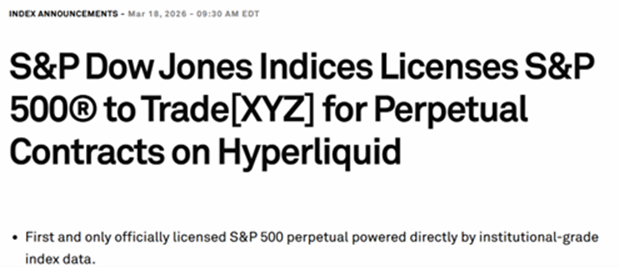
S&P Dow Jones Indices officially licensed the S&P 500 to Trade[XYZ] for a perpetual contract on Hyperliquid (HYPE, “D”).
Let that sink in a moment.
The S&P has an officially licensed product trading on-chain. That’s historic.
This isn’t symbolic or performative. The how and why behind this move matter. And they suggest the massive surge in tokenization is ahead.
Let me explain …
Traditionally, when market-shaking news hits over the weekend, traders are stuck sitting on their hands until Monday morning.
But we know that crypto markets are always open. And traders can make moves all day, every day.
We saw how that discrepancy plays out in real time.
Earlier this month, as the Iran War was first breaking out, oil-related trading surged on-chain. But, since it was a Sunday, TradFi and institutional traders were left out.
And on Monday morning, they were stuck playing catch-up.
For institutions, the question is evolving beyond whether crypto belongs on their balance sheets. Now, many ask when they can benefit from the blockchain’s always-on, instant settlement technology.
Because the ones that make the move on-chain first will have a serious advantage.
Trade[XYZ] is already the largest real-world asset market on the platform, with over $100 billion in reported volume since October and an annualized run rate exceeding $600 billion.
The S&P 500 is the flagship index. And additional markets are already planned.
If you’ve been waiting for a sign to gain exposure to the real-world asset (RWA) and tokenization narratives, this is it.
Your experts have covered RWA opportunities several times, including …
- The MetaMask/Ondo team up that brings RWA trading right to your wallet.
- BlackRock’s BUILD fund moving on-chain via Uniswap (UNI, “B-”)
- And how Franklin Templeton and Binance are helping institutions maintain custody of their collateral.
Now, it’s time to do your own research — with the help of our Weiss crypto ratings — to find the RWA play that’s right for your portfolio.
Afterwards, be sure to check out the other actionable insights your crypto experts had for you this week …
What My Model Says About … Oil?
Juan Villaverde’s Crypto Timing Model has accurately called the tops and bottoms of the past three crypto cycles. But did you know it works for any asset with a price chart?
Since the market is moving to the beat of oil’s drum, Juan used his model to map out what’s next for black gold. And in his latest update, he shares the three key dates it highlighted … and what they likely mean.
2 Ways to Play the Emerging 2-Tiered Crypto Market
Real-world assets aren’t the only infrastructure plays you should have on your radar. Privacy protocols are beginning to see a shift: A new subset has begun to search specifically for a balance between privacy and transparency in a way that makes both regulators and asset managers happy.
According to tech expert Jurica Dujmovic, a window of opportunity is emerging for infrastructure plays like this. But it won’t be open long.
Crypto’s New Rule Book Has Arrived
Infrastructure plays mean you have to get in early to really make the most of that opportunity. And with crypto’s new rulebook, those opportunities are becoming clearer for everyone to see.
Mark Gough breaks down these new rules, how they’re expected to benefit crypto broadly and how you can still stay one step ahead.
Easily Avoid This $50 Million DeFi Disaster
The benefit of DeFi is also its greatest drawback: personal agency. In DeFi, you are empowered to be your own bank, broker and everything in between. But that also means you have to be your own risk analyst. And ultimately, if anything goes wrong, the buck stops with you.
Take, for example, the individual who lost roughly $50 million by not reading the fine print. That’s an insanely costly mistake. DeFi expert Marija Matić highlights where they went wrong, and how you can avoid doing the same.
Just $602 Makes You a Billionaire in Tehran
War is a great destroyer of paper currency. We’re seeing that play out right now in Iran, as the Iranian rial plummets. As of writing, the exchange rate is a whopping 1 USD = 1,659,500 IRR.
But as the rial crashed, we saw something else play out in real time: crypto’s success. Not even internet blackouts could stop Iranians from trading their crypto. That’s proof of what experts have said for years: In times of crisis, decentralized currencies come in clutch.
In his update, Bob Czeschin reveals three ways Iranians were able to access their crypto without an internet connection so you can access your wallet wherever you go, too.
But that’s all for this week. Be sure to look for your next Weiss Crypto Daily update tomorrow afternoon.
Best,
Beth Canova
Crypto Managing Editor